The most common mistakes accredited investors make when evaluating a real estate syndication are not about the numbers. They are about expectations - about what the asset class is, what a hands-on operator actually does, what distributions look like on a heavy value-add deal, and how long the money is genuinely going to be tied up. Dave Lamattina has been on thousands of first calls over 22 years. The same misconceptions come up reliably. Getting them right before committing capital is how LPs avoid being surprised mid-hold.
Key Takeaways
- Class B/C does not mean high risk by default. The asset class carries more management intensity than Class A. It does not automatically carry more investment risk, especially when the operator has 22 years of experience in the specific market and product type.
- Heavy value-add deals do not pay distributions from day one. If the property needs 18-24 months of renovation before it stabilizes, there will be no distributions during that period. This is not a problem - it is how the business plan is engineered to deliver the highest returns overall. Investors who need immediate income should invest in stabilized assets.
- Hold periods are a range, not a guarantee. Arrowpoint underwrites to a 5-year hold and puts on 5-7 year fixed-rate debt. The deal might exit in year 3 if the offer is compelling enough. It might run to year 6 if the market is soft. Investors who need their capital back at a specific date are not a good fit for this structure.
- Supply in the Merrimack Valley is not like supply in Sun Belt markets. New investors often ask about supply risk because they have seen what oversupply does to occupancy in high-growth metros. The Merrimack Valley has almost no new workforce housing in the pipeline. This is a structurally different supply environment.
- Hands-on means the CEO is actually involved. Arrowpoint self-manages every property. Dave's regional manager reports to him daily. He has been on site for every major renovation project. Hands-on is not a marketing term here - it is a description of how the business runs.
- The return targets vary by deal type. A heavy value-add 1970s asset targets 18-22% IRR with 6%+ year-one cash-on-cash, deferred until renovations are complete. A core-plus 2000s-vintage asset targets 15-16% IRR with year-one cash flow from day one. Knowing which type you are investing in determines what you should expect.
The questions investors ask on first calls reveal as much about fit as they do about diligence. An investor asking about quarterly distributions on a heavy value-add deal is telling you something about what they actually need - and whether this deal is the right vehicle for them - which is what it really means to know how to invest in real estate syndications.
Subscribe to our educational newsletter and join the priority waitlist for our next offering
What the First Call Actually Looks Like
A typical first call with a new prospective investor follows a predictable structure. Dave starts with an overview of Arrowpoint - what the firm does, where it operates, the track record in broad terms, and what kinds of deals are currently being looked at. If there is a specific deal being marketed, that becomes the focus once the background is covered. Then questions.
The follow-up after the call is consistent: a deck or track record document by email, a check-in a week later to see if there are further questions, and then the investor either moves forward to documents or does not. The process is not high-pressure. Dave is not trying to close everyone who gets on a call. He is trying to figure out whether the investor understands the deal and whether the deal is right for them.
That screening function matters more than it might seem. An investor who commits to a 5-year hold on a heavy value-add deal expecting quarterly income in year one is going to be unhappy by month 18 when the renovation program is still running and no distributions have gone out. That unhappiness does not help anybody. Better to surface the mismatch on the first call than six months into the deal.
Misconception 1: Class B/C Is Too Risky
The most common misconception Dave encounters from newer or more institutionally oriented investors is that Class B/C workforce multifamily is categorically higher risk than Class A. Some institutional capital has effectively redlined older vintage assets - they have decided that the 1970s garden-style building is not a product they will touch, regardless of the market or the operator.
There is something real behind this concern. Class B/C does require more active management than a stabilized Class A asset in a strong metro. Tenants in workforce housing are more likely to rely on state assistance, more likely to experience employment disruption, and less likely to leave voluntarily. Maintenance issues on a 50-year-old building come up more often than on a 15-year-old building. None of this is a surprise to Arrowpoint, and none of it is an argument against the asset class.
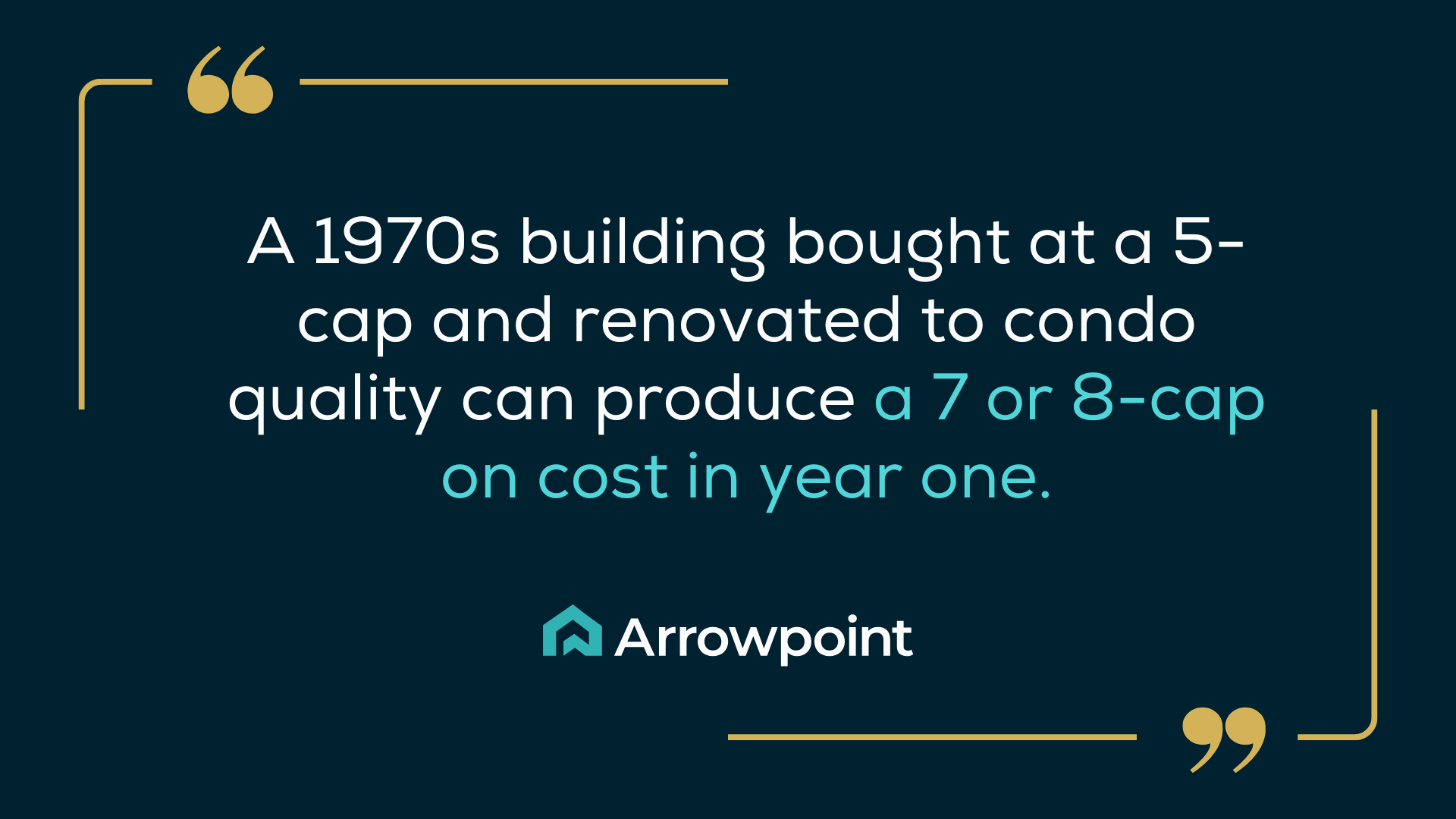
The risk in Class B/C is real but manageable - and it comes with a corresponding return profile that Class A cannot offer. A 1970s building bought at a 5-cap, renovated to condo quality, and re-leased at market rents can produce a 7 or 8-cap on cost in year one – an immediate increase in cash flow and increase in property value. That is where the 18-22% IRR target on heavy value-add deals comes from. The margin for error is larger. So is the margin for gain.
The mitigation is operator knowledge. Arrowpoint has bought dozens of buildings in the Merrimack Valley across 22 years. Before closing on any deal, the team knows what the renovation will cost, what the building needs that the inspection will not find, what the tenant profile looks like, and what the exit market will support. That knowledge does not make the asset less management-intensive. It makes the investment less risky, because the unknowns are smaller.
Misconception 2: Distributions Start Immediately
On a heavy value-add deal - a 1970s building with significant deferred maintenance, below-market rents, and a renovation program planned for 50 or more units - distributions are not going to start on day one. They are not going to start in month six. They probably will not start for 18 to 24 months.
This is how value-add business plans generally work – the value in a heavy value-add deal is created through the renovation program – units renovated to higher quality command rents that a neglected 1970s unit cannot. The property has to be stabilized before those rents are flowing at scale, and stabilization takes time. During that period, cash from operations goes into the renovation, not out to investors.
Arrowpoint is direct about this on every deal of this type. The offering materials say it. Dave says it on the call. There is no ambiguity about when distributions are expected to begin, and investors who need current income are steered toward the stabilized assets in the portfolio rather than the heavy value-add projects.
The flip side is the back-end return. A property bought for $20M that runs through a full renovation program and exits for $32M over five years produces a return that quarterly distributions from a stabilized asset cannot match. The investor who can wait - whose capital is genuinely patient - gets the better outcome. But only if they understood from the beginning what waiting would look like.
Misconception 3: The Hold Period Is Fixed
Arrowpoint underwrites to a five-year hold and structures debt with a five to seven-year fixed term. That framing leads some investors to treat the five-year hold as a firm commitment - a date on which they will receive their capital back.
The hold period is a planning assumption, not a guarantee. River's Edge, Arrowpoint's 2016 Haverhill acquisition, was underwritten as a five-year hold with seven-year Fannie Mae debt. An offer came in at year three that was too strong to decline. Arrowpoint paid $1.5 million in yield maintenance to exit the debt early and returned 32% net IRR to investors. The hold was three years, not five, because the market gave Arrowpoint a number that made early exit the right call.
The opposite is also true. Appleton Square in Methuen went to market in early 2025 expecting to close at $40-42M based on the broker's opinion of value. The offers came in materially below that. Arrowpoint pulled the property off the market and decided to hold. That deal is still in the portfolio. The five-year plan extended because the exit market did not cooperate.
Investors who have a specific liquidity need - capital that must be returned by a certain date for another purpose - should not be in a real estate syndication. The structure does not accommodate that kind of constraint. Investors whose capital can stay patient, who understand that the sponsor will exit when the timing is right rather than when the calendar says to, are the ones the deal structure serves well.

Misconception 4: Supply Risk Is the Same Everywhere
New investors often arrive with a supply question borrowed from other markets. They have seen what happened in Austin or Phoenix when thousands of new Class A units delivered in the same submarket simultaneously - concessions, occupancy pressure, rent growth stalling or reversing. They want to know whether the same thing can happen in the Merrimack Valley.
The answer is that the Merrimack Valley operates on a structurally different supply dynamic. Lawrence has a rental vacancy rate that consistently sits around 1.4%. The workforce housing stock is almost entirely pre-1980 vintage. The cost to build new multifamily in Massachusetts - land, labor, permitting, construction costs - means that a developer cannot build at rents that workforce tenants can afford without subsidy. The per-unit gap between construction cost and what workforce rents can support runs to over $200,000 per door. Private capital does not build into that gap without public money.
This means the supply story in the Merrimack Valley is not the same as the supply story in markets where new construction is economically viable at market rents. When Arrowpoint renovates a 1970s unit, the tenant has no comparable new-construction alternative at a price point they can afford within commuting distance of their job. That scarcity is structural, not cyclical. It does not go away when interest rates change or when institutional capital shifts focus.
The supply question is worth asking. The answer in this market is different from the answer in markets investors may be more familiar with.
Misconception 5: Hands-On Is a Marketing Term
Most real estate syndication sponsors describe themselves as hands-on operators. The phrase has been used so frequently that it has largely lost meaning and investors have learned to discount it.
At Arrowpoint, it is a literal description of how the business runs. Arrowpoint self-manages every property in the portfolio - no third-party property management. Dave's regional manager reports to him directly. Every major renovation project has had Dave on site. When a maintenance issue arises at a Lawrence property, the response comes from people who are 30 minutes away and who know the building, not from a regional management company three states away running a portfolio of 50 assets.
This matters for a few reasons. First, self-management means the operating data flows directly to the ownership team without a third-party filter. Dave knows what occupancy, collections, and maintenance costs look like at any given moment because the people generating that data report to him. Second, it means that decisions about a property - whether to renovate a unit, how to handle a collections issue, when to replace a roof - are made by the same people who own the asset, not by a contracted manager whose incentives may not be perfectly aligned.
Third, and most practically: when something goes wrong, the person responsible is the person who owns the problem. There is no management company to blame, no third party to negotiate with. Arrowpoint fixes it.
Misconception 6: IRR Is the Right Metric to Lead With
Investors who have been in the space for a while often arrive with an IRR number in mind - 20%, 25%, whatever they have been quoted elsewhere. They want to know how Arrowpoint's deals compare. The question is reasonable. The IRR as a comparison tool is less reliable than it appears.
IRR is sensitive to timing. A deal that returns capital quickly produces a higher IRR than one that holds longer, even if the equity multiple is the same. A sponsor who knows this can engineer a projected IRR by shortening the assumed hold period in the model. Dave is direct about this: he thinks IRR is manipulable, and he is more focused on the equity multiple - how many times does the investor get their money back - as the measure that matters.
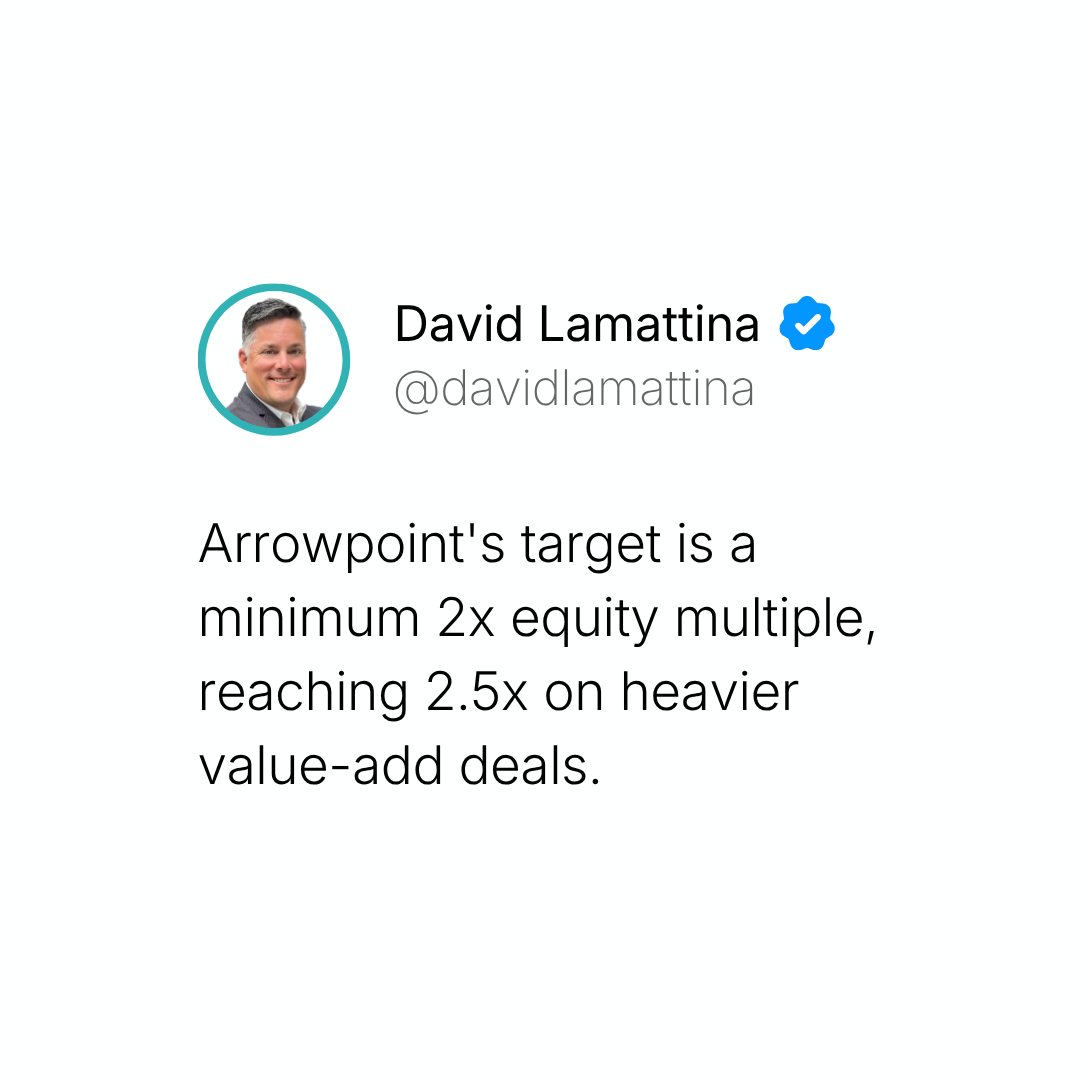
Arrowpoint's target is a minimum 2x equity multiple on most deals, with heavier value-add deals sometimes reaching 2.5x. That means an investor who puts in $100,000 expects to receive $200,000-$250,000 back over the hold period, inclusive of all distributions and return of principal. On core-plus deals with a lighter renovation profile, the target multiple is slightly below 2x, reflecting the lower risk and lower return profile of those assets.
The IRR targets follow from the equity multiple and the hold period: 18-22% on heavy value-add 1970s assets, 15-16% on core-plus 2000s-vintage deals. Both types target 6% or better year-one cash-on-cash on stabilized deals, or year one of positive operations on value-add deals after the renovation is complete. The numbers are real projections grounded in conservative underwriting, not optimistic assumptions dressed up to win the deal.
What Investors Should Actually Be Asking
The questions that matter most on a first call are the ones about the sponsor's methodology, not the ones about projected returns. Returns are a projection. Methodology is what you can evaluate.
What is the debt structure? Fixed or floating, what term, what LTV, what happens at maturity? A deal that works at a 6% fixed rate for seven years is a different risk proposition from one that relies on a floating rate coming down to make the numbers work.
Has the sponsor ever had a capital call? If not, how? The absence of capital calls over a long track record on older buildings is the result of renovation budgets that account for the unforeseen and debt structures that can sustain a rough quarter without triggering a lender event.
How does the sponsor make money, and is it aligned with how the investor makes money? A sponsor who collects a large acquisition fee at closing and an asset management fee regardless of performance has a different incentive structure from one who co-invests in every deal and collects the majority of their profit at exit alongside the LPs.
Does the sponsor self-manage? Third-party management creates a principal-agent problem. The interests of the management company and the ownership are not identical. Self-management eliminates that gap.
These questions are harder to answer with a number than projected IRR. They are also harder to fake - which is why a record of never having lost a dime of investor capital matters more than any pitch.
Frequently Asked Questions
Should I expect distributions from day one on an Arrowpoint deal?
It depends on the deal type. A stabilized or core-plus asset - a 2000s-vintage property with a light renovation program and existing cash flow - should begin producing distributions relatively quickly, typically within the first year. A heavy value-add deal with a significant renovation program and below-market rents going in will not produce distributions until the property is stabilized, which typically takes 18-24 months. Arrowpoint specifies the expected distribution timeline in the offering materials for every deal, and Dave covers it on the first investor call. There is no ambiguity about what to expect.
What is the minimum investment in an Arrowpoint deal?
Minimums vary by deal and structure. Individual syndications have typically had minimums in the range suited to accredited investors building a diversified private real estate allocation. The Arrowpoint Multifamily Fund I had a minimum commitment of $250,000, called in increments as deals were acquired over the investment period. For current deal minimums, contact Arrowpoint directly, as they vary by offering.
What questions does Arrowpoint ask investors before accepting their capital?
Arrowpoint conducts standard accredited investor verification and the required anti-money laundering, know-your-customer, and OFAC checks through the subscription process. Beyond the regulatory requirements, Dave pays attention to the fit between what an investor is looking for and what the deal actually offers. An investor who needs their capital back in three years, who expects quarterly income on a heavy value-add deal, or who has never invested in private real estate before may not be the right fit for a given offering - and Dave will say so rather than take the capital and deal with the mismatch later - a discipline rooted in what his father first taught him about investor relationships.
How does Arrowpoint handle a deal that is not performing to plan?
The first step is identifying the cause. On one property in the portfolio, occupancy dropped and collections softened over a period of time. The root cause turned out to be a staffing issue - the on-site team was not performing. Arrowpoint replaced the staff, brought in new personnel, got them trained, and occupancy and collections recovered. Investors received an email update explaining what happened and what was being done before the next quarterly report went out. The approach is consistent: here is the problem, here is the solution, here is how we are executing on it.
Is it safe to invest in workforce housing given the tenant profile?
Workforce housing tenants are renters for life in most cases. They are not saving for a down payment and moving on in two years the way some Class A tenants do. Demand is persistent and relatively inelastic - people need somewhere to live regardless of what the economy is doing. The management intensity is higher than with a Class A asset, and collections can be more variable. Arrowpoint's 22 years of operating in workforce housing in the same market, and its 26-deal track record with no loss of investor capital, is the most direct evidence available about what that risk profile actually produces over time.
Next Steps
For investors who are earlier in the process and want to understand how to evaluate any real estate syndicator, not just Arrowpoint, our article on how to invest in real estate syndications covers the full framework - what to look for in a track record, how to read the debt structure, what questions to ask before wiring capital.

David Lamattina
President & CEO
About Dave Lamattina
Dave Lamattina is the founder and CEO of Arrowpoint Properties, a vertically integrated multifamily owner-operator based in Lawrence, Massachusetts. He has been acquiring and operating multifamily assets in the Merrimack Valley for over 22 years, with 1,100+ units acquired and exited and a current portfolio of approximately 850 units valued at around $230 million. Arrowpoint has completed 26 syndications with an average net IRR of 32% and a 2.50x equity multiple.