Arrowpoint Properties has completed 26 real estate syndications over 22 years without losing a single dollar of investor capital. Every LP who has invested in an Arrowpoint deal has received 100% of their principal back plus a return on top of it. No deal has ever gone to receivership. No capital call has ever been issued to investors. That record is the product of three things applied consistently across every transaction: conservative debt, conservative underwriting, and a budget discipline that accounts for what you do not know you do not know.
Key Takeaways
- 26 deals, zero capital losses. Every investor who has committed capital to an Arrowpoint syndication has received their principal back plus a return. This is not a claim about average performance - it is a statement about the floor.
- No deal has ever gone to receivership. Lender-forced takeover has never even been close to an issue. The debt structure on every deal has been fixed-rate, agency or conventional bank debt, at 70-75% LTV - conservative enough to hold through market stress without triggering a covenant breach.
- No capital call has ever been issued to LP investors. Arrowpoint has bought and renovated dozens of older buildings, many in significant disrepair. The absence of capital calls reflects both the conservatism of the renovation budgets and the contingency reserves built into every deal for unforeseen costs.
- The closest thing to a capital call involved only the GP. On one deal with no outside LPs, Dave and his partner covered a quarterly payment shortfall out of their own pockets during a rough HVAC quarter. That is the extent of it.
- The worst deal in 22 years is an active deal with a capital stack issue, not an asset problem. The first deal in the 2022 fund required preferred equity to close the raise when the debt markets blew up. The deal is still active, the asset is fine, and the issue is that the capital structure compressed LP returns below initial projections.
- The track record was built on methodology, not luck. Fixed-rate debt, 0-2.5% rent growth assumptions, cap rate expansion at exit, and an unforeseen-cost reserve on every deal. None of these are dramatic. All of them help protect investor capital from downside pressures.
A 22-year track record with no capital losses is rare in real estate syndication. What matters to a sophisticated LP is not just the outcome but the methodology that produced it - because the methodology is what gives you confidence about future deals, not just past ones - which is the heart of how to invest in real estate syndications.
Subscribe to our educational newsletter and join the priority waitlist for our next offering
The Question Dave Volunteers
When Dave Lamattina is on a first call with a prospective investor, there is one question he has learned to raise himself if the investor does not: have you ever lost money on a deal? He has noticed that about half of new investors ask it, and half do not. He answers it for both groups.
The answer is the same either way. In 22 years and 26 syndications, Arrowpoint has never lost investor money. Every deal that has exited returned 100% of LP principal plus a profit. No deal has ever been taken into receivership by a lender. That outcome - no loss of capital across more than two decades - is not something Dave presents as a boast. He presents it as a methodology, because that is what it is.
The methodology is not complicated. It is also not easy to execute consistently across 26 transactions, multiple market cycles, and a portfolio that has included some severely distressed assets. The fact that Arrowpoint has done it is a function of a few principles applied without exception.
The Debt Structure
Every Arrowpoint deal has been financed with fixed-rate debt at 70-75% LTV. The sources have been either conventional bank debt or agency - Fannie Mae or Freddie Mac. No bridge loans. No floating-rate structures. No rate caps that expire and leave the deal exposed to a refinancing event at a higher rate.
The LTV cap is a deliberate choice, not a lender constraint. Dave has been offered higher leverage - some lenders will go to 80% - and has declined. The equity cushion at 70-75% provides downside protection. If asset values soften, the deal can still be held without triggering a loan covenant. If the renovation takes longer than expected, the fixed rate provides cost certainty. If the exit market is soft when the loan matures, there is flexibility to hold and wait rather than being forced to sell.
The rate on Arrowpoint's most recent major acquisition - the Elora deal in Lawrence, over 100 units, financed with a 7-year Fannie Mae loan - is locked for the full term. The business plan does not depend on a favorable refinancing event. That matters when markets move unexpectedly.
The debt discipline is also why Arrowpoint's 2022 fund deal is the closest thing to a problem in 22 years - and even that did not result in a capital loss. The fund launched in spring 2022, the rate markets moved sharply, raising equity became difficult, and the first deal required preferred equity from a California firm to complete the capital stack. The asset itself is solid. The compression on LP returns comes from the preferred equity's priority position in the waterfall, not from the property underperforming as a business. The lesson was structural, not operational.

The Underwriting
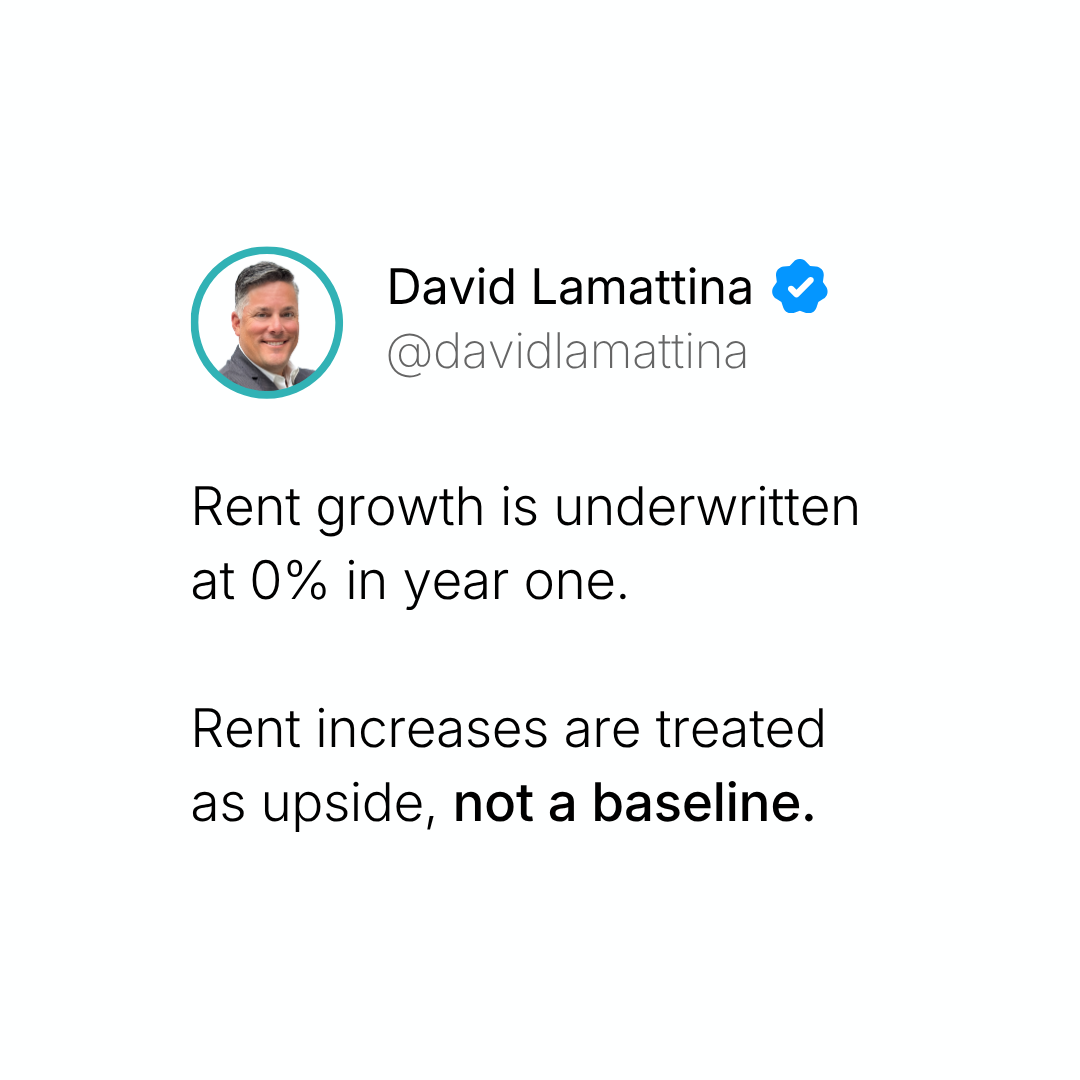
Arrowpoint underwrites rent growth at 0-2.5% in the current environment, with 0% assumed in year one on most deals. That assumption runs against the instinct of a value-add operator, who has historically counted on rent increases to carry the business plan. Dave's view is that the rent increases should be treated as upside, not as a baseline - and that the deal should work even if rents stay flat.
The exit cap rate is always underwritten with some expansion assumed relative to the going-in cap. Arrowpoint does not model cap rate compression at exit. If the exit market happens to be favorable and caps compress, the result is a stronger return than projected. If the market is flat or slightly worse, the deal still works.
The underwriting also assumes a conservative expense ratio. Rather than projecting large reductions in operating costs, Arrowpoint tends to model expenses at or slightly above current levels. The value creation comes from rent improvement and forced appreciation through renovation, in addition to using conservative property management improvement assumptions.
Stress-testing takes the form of running the model at different scenarios - 0% rent growth, 2% rent growth, expenses up 10% - and checking whether the deal still makes sense at each level. The question Dave asks is not whether the model looks good at the best-case scenario. It is whether the deal survives the scenario where several things go slightly wrong at once.
The Renovation Budget and the Unforeseen Reserve
Arrowpoint has bought a lot of old buildings. 1960s and 1970s garden-style multifamily, long-term family ownership that stopped spending on maintenance years before the sale, properties where the health department sent thank-you calls when Arrowpoint took over. In that kind of asset, things will go wrong that the inspection did not catch and the PCR (Property Condition Report) did not flag.
A third-party PCR is standard on every Arrowpoint acquisition. These are thorough, covering mechanicals, roof, windows, foundation, and everything else with an age and replacement timeline. They are also incomplete by definition, because an inspection is non-invasive. You do not dig up the ground to check the drainage. You do not open walls to see what the plumbing looks like.
On one Worcester acquisition, Arrowpoint discovered after closing that water was intruding into ground-level units through a drainage problem around the building's perimeter. Trenching the perimeter and installing a proper drain system cost over $50,000 that was not in the original budget. On the Elora acquisition - a 2009-vintage property that passed a full PCR - an interview with the outgoing property manager revealed that the HVAC serving the common areas and hallways had been non-functional for some time. The prior owner knew. They had not disclosed it. There was no recourse after due diligence closed.
Both of these situations were handled without a capital call because both deals had a reserve built into the budget specifically for situations like these. The reserve is not a line item that gets optimized away to make the returns look better in the pro forma. It is a fixed part of every renovation budget, sized to absorb the unexpected costs that 22 years of buying older buildings has taught Arrowpoint to expect.
The One Situation That Came Close
The nearest Arrowpoint has come to a capital call on an LP deal is not actually a capital call story. It involves a deal with no outside LPs - just Dave, his partner, and a debt fund as the only capital sources. One quarter, HVAC failures across several units hit at the same time. The cash flow in that quarter was not enough to cover the required payment to the debt fund. Dave and his partner covered the shortfall out of their own pockets.
That is the extent of it. One quarter, one private deal, no LPs affected. The situation resolved as the HVAC work was completed and the building returned to normal operations.
Across all 26 LP syndications, no equivalent situation has occurred. Arrowpoint has never asked LP investors to contribute additional capital for any reason.
The Distributions
In 22 years of operations, Arrowpoint has never missed a distribution - though in the first months of COVID, when nobody knew what was coming and holding cash reserves seemed like a prudent call, distributions were deferred temporarily. That is the only instance. Quarterly distributions have otherwise landed consistently.
K-1s go out by end of February. Dave has been on the other side of this as a passive LP in other deals, waiting until summer for tax documents that hold up a personal return. He does not run his investor communications that way.
The quarterly reports go out on a schedule. Dave notes that the open rate on those reports is lower than you might expect - when the deal is performing and distributions are arriving, most investors do not read in detail. When something changes, he sends an email update before the next quarterly report, explains what happened and what is being done about it, and makes himself available for follow-up. The formula is not complicated: here is the problem, here is what we are doing about it.
What the Track Record Actually Means
A 32% average net IRR across 26 syndications is a compelling headline. The 2.50x average equity multiple is the number Dave tends to focus on, because it is an easier number to understand than the IRR - it simply shows that investors who put in $1 got $2.50 back, on average, including all distributions and return of capital.
Neither number is the most important thing about the Arrowpoint track record. The most important thing is that no LP has ever lost money. That outcome requires sustained discipline over a long time - and it requires that discipline to hold even when markets make it easier to stretch the underwriting, take on more leverage, or skip the unforeseen reserve to hit a cleaner projected return.
The 2022 fund deal is useful here precisely because it is the exception. It is the one deal out of 26 where the structure did not work as intended, where projected LP returns are likely to come in below what was initially presented. And even in that case - the hardest case in 22 years - the asset is producing, no capital has been lost, and the deal is being held until the exit market improves. The methodology held.
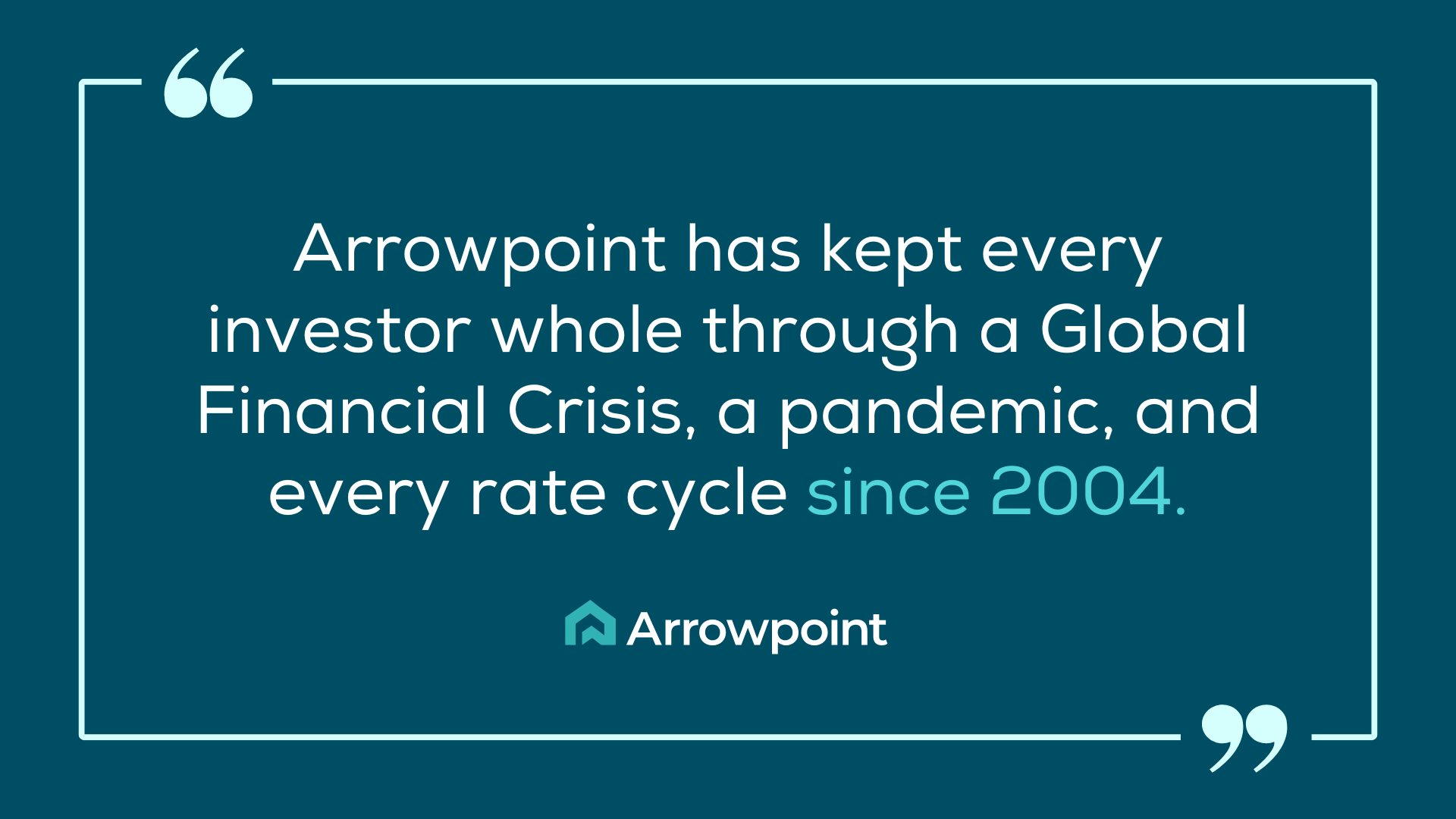
That is what 22 years without a capital loss actually looks like. Not a perfect record of deals that performed exactly as modeled. A consistent methodology that has kept every investor whole across boom markets, rate spikes, a pandemic, a Global Financial Crisis, and everything else the market has thrown at the Merrimack Valley since 2004.
Frequently Asked Questions
Has Arrowpoint ever had a deal go into receivership?
No. Receivership has never been close to an issue on any Arrowpoint deal. The firm's debt structure - fixed-rate, 70-75% LTV, agency or conventional bank sources - provides enough cushion that lender-forced actions are not a realistic scenario under ordinary market stress. The closest Arrowpoint has come to a structural problem was the 2022 fund deal, where preferred equity in the capital stack compressed LP returns. The asset itself is performing and there has been no lender action.
Has Arrowpoint ever issued a capital call?
No capital call has ever been issued to LP investors across 26 syndications. On one private deal with no outside LPs, Dave and his partner covered a quarterly shortfall out of pocket during a period of elevated HVAC expenses. That is the extent of it. The absence of capital calls on LP deals reflects both the renovation budget discipline and the unforeseen-cost reserves built into every transaction.
What is the worst deal Arrowpoint has done?
Dave's answer to this question is honest: the worst active deal is the first asset placed into the 2022 fund, where the capital structure included preferred equity from a California firm because the debt markets blew up during the raise and raising LP equity became difficult. The asset is performing. The preferred equity's priority position in the waterfall has compressed what LP investors will receive relative to initial projections. The deal has not been sold yet - the exit market was soft when Arrowpoint tested it and the decision was made to hold and wait. Among completed deals, Dave cannot point to one that failed. Every exited deal has returned principal plus a profit to investors.
How does Arrowpoint handle unexpected costs that arise after closing?
Every renovation budget includes a reserve specifically for costs that inspections and PCR reports do not catch. This is a planned allocation based on the experience of buying older buildings where unforeseen issues are a certainty, just not predictable in their specific form. The drainage problem in Worcester cost over $50,000 above the original budget. The Elora HVAC issue is still being assessed. Both situations have been managed within deal budgets without affecting LP capital. When something unexpected happens, Arrowpoint communicates the situation to investors by email, explains what it is and what is being done, and makes follow-up available by phone.
How conservative is Arrowpoint's underwriting?
Current underwriting assumes 0% rent growth in year one and 2-2.5% in subsequent years - well below what the Merrimack Valley has historically produced and below the inflation rate. Exit cap rates are modeled with expansion assumed, not compression. Expense ratios are held at or above current levels rather than projected to improve. The deal needs to work at those conservative assumptions before Arrowpoint will close on it. If it only works on an optimistic scenario, it does not get done - the same discipline behind our 15-20% rule for renovation spending.
Learn More
The article on how Arrowpoint structures deals for LP investors covers the return targets, hold periods, distribution schedule, and what the investor experience looks like from first call through exit.
For a broader look at how to evaluate a real estate syndicator's track record - what the numbers mean, what questions to ask, and what to look for beyond the headline IRR - see how to invest in real estate syndications.

David Lamattina
President & CEO
About Dave Lamattina
Dave Lamattina is the founder and CEO of Arrowpoint Properties, a vertically integrated multifamily owner-operator based in Lawrence, Massachusetts. He has been acquiring and operating multifamily assets in the Merrimack Valley for over 22 years, with 1,100+ units acquired and exited and a current portfolio of approximately 850 units valued at around $230 million. Arrowpoint has completed 26 syndications with an average net IRR of 32% and a 2.50x equity multiple.