The reason workforce rental housing doesn't get built in Lawrence, Methuen, or Haverhill has nothing to do with zoning and everything to do with arithmetic. According to MassINC's 2025 Gateway Cities Housing Monitor, the gap between what it costs to build a new rental unit and what workforce-level rents can support financially is approximately $212,000 per unit.
That gap has to be filled by public programs - tax credits, grants, subsidized land - for a project to pencil. Without them, no private developer builds. Lawrence and Haverhill rank among the deepest-gap cities in MassINC's analysis. That figure held steady from 2024 to 2025. This is a structural problem, and it has been structural for as long as Arrowpoint has been buying buildings in this market.
In 22 years of acquiring multifamily in the Merrimack Valley, we have watched exactly zero new workforce rental developments get built in our core markets.
Key Takeaways
- The $212,000 gap is the reason workforce housing doesn't get built - it is the difference between what construction costs and what rental income from working households can support, and it cannot be closed by private capital alone.
- Zoning reform has not moved the needle - every community in the Merrimack Valley Planning Commission region now has MBTA Communities-compliant zoning. New workforce supply has not followed, because permission to build is not the same as an economic reason to build.
- The new projects that do get built are not competing with workforce stock - downtown Class A developments in Haverhill and Lawrence target a different tenant at a different price point. They do not fill the gap.
- Existing workforce housing stock is effectively irreplaceable - approximately 48% of Haverhill's housing units were built before 1960. Essex County housing permits in 2024 ran at less than 60% of 2021 levels.
- For investors, the gap is the thesis - every year the $212,000 problem holds, the competitive moat around existing workforce stock widens. New supply does not arrive to reset rents.
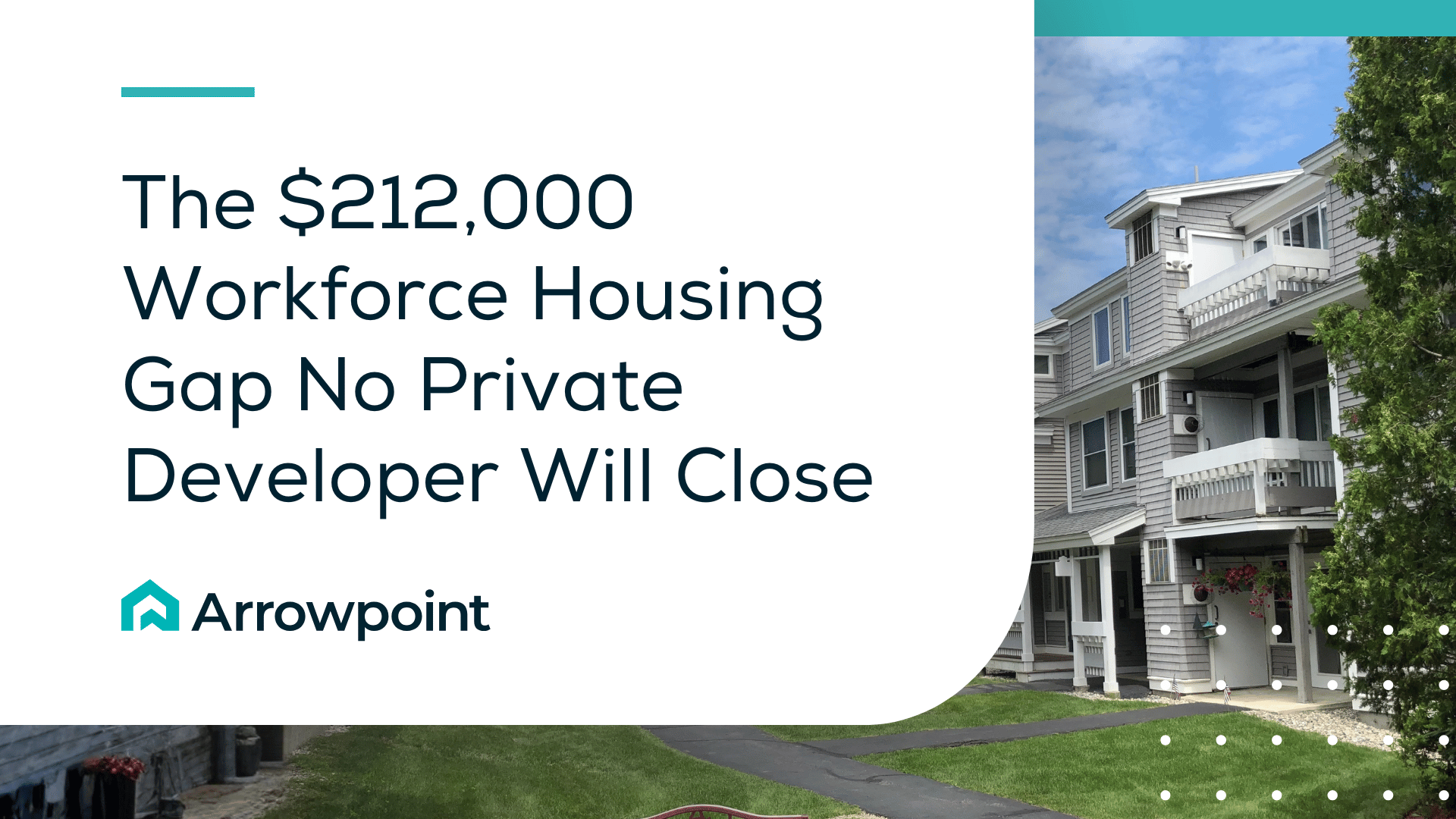
What the $212,000 Actually Is
The mechanics of the gap are straightforward.
Building a new apartment unit in the Merrimack Valley costs what it costs: land, materials, labor, permitting, carrying costs through a multi-year approval process, and developer profit. That number in today's construction environment runs well north of $300,000 per unit in most configurations. To generate a return on that cost basis, a developer needs rents that the workforce tenant simply cannot pay.
A workforce renter - a home health aide, a warehouse worker, a school custodian - earns somewhere in the range of $55,000-$75,000 a year. Housing economists consider a household cost-burdened when rent exceeds 30% of income. At that income level, the affordable ceiling is roughly $1,400-$1,800 per month. New construction math and workforce affordability do not meet.
The $212,000 figure from MassINC represents the financial gap between those two numbers - what it costs to build a unit and what workforce-level rents can support - expressed per unit. Bridging it requires public intervention: tax credits, grants, subsidized land. Without that intervention, no private developer builds at the workforce level. With it, the projects that get produced are typically deeply affordable - Section 8, income-restricted housing - which serve a different population than the workforce renter Arrowpoint houses.
Arrowpoint operates in the space that neither new construction nor subsidized housing reaches. Buying existing stock at acquisition costs well below today's build cost means the return works at rents workforce tenants can actually pay. A new construction developer cannot replicate that math.
The existing stock, bought right and managed well, is the only private-market solution to workforce housing in this region. According to MassINC, the income and rent gap has been persistent across multiple years of analysis and shows no sign of narrowing as construction costs continue to rise.
The middle is not empty for Arrowpoint. It is the market.
Subscribe to our educational newsletter and join the priority waitlist for our next offering
Why Zoning Reform Doesn't Solve It
One response to a housing shortage is to fix the zoning. Massachusetts made a serious attempt at this.
By December 2025, all 15 Merrimack Valley Planning Commission member communities had adopted MBTA Communities-compliant zoning - making the MVPC region the only Regional Planning Agency in Massachusetts where every community met the requirement. New zoning, in place, across the board, in every city and town.
The $212,000 gap didn't move.
Permission to build is not the same as an economic reason to build. Developers looked at the newly compliant zoning and ran the same numbers they had always run. Construction costs hadn't changed. Workforce rents hadn't changed enough to close the gap. The projects that did get permitted and built - Merrimack Street in Lawrence (390 units), Oxford Crossing (230 units), The Beck in Haverhill (290 units) - are downtown Class A developments targeting a different tenant at a different price point. A young professional, a dual-income couple, someone relocating for a healthcare job. Not the working-class renter who has lived in the Valley for 20 years and earns $60,000 a year.
Those Class A projects are real additions to the housing stock. They do not compete with Arrowpoint's product. They do not fill the workforce gap. They are a different market.
Lamattina has watched this play out since the early 2000s. Developers announce projects. Some get built - at the high end. The workforce middle stays empty.
What Old Housing Stock Means for the Investment Case
Because nothing gets built at the workforce level, the existing stock is effectively irreplaceable.
Approximately 48% of Haverhill's housing units were built before 1960, according to U.S. Census Bureau data. Lawrence's figures are similar. These are 1960s and 1970s garden-style complexes, brick three-deckers, mid-century walk-ups - buildings that require capital investment to maintain but that cannot be replicated at any price workforce rents can support.
Lawrence's rental vacancy sits at approximately 1.4% - far below the 5-7% range considered necessary for a balanced market. Essex County housing permits in 2024 ran at less than 60% of 2021 levels, per U.S. Census Bureau building permit data. Supply is not coming.
When Arrowpoint renovates a unit in a 1970s garden-style complex - new flooring, quartz countertops, updated kitchen, condo-quality finishes - the tenant paying the resulting rent has no comparable alternative at that price point within a reasonable commute of their job. There is no new workforce development down the street. There is no pipeline of projects that will reset the market in two or three years.
The buildings Arrowpoint buys are not competing with new supply. In the workforce segment, they are the supply - the foundation of our broader Merrimack Valley investment thesis.
What This Means for an Investor
The Merrimack Valley is a durable market that is structurally supply-constrained where demand is persistent, vacancy is near zero, and no private developer will build the product that competes with existing workforce stock. The $212,000 problem is one of the conditions that makes our investment thesis work.
Every year that gap holds, the competitive moat around existing workforce housing widens. New supply does not arrive to reset rents. Tenants who need an affordable unit within commuting distance of a Merrimack Valley job do not have a cheaper alternative. Operators who own and manage the existing stock well do not have to outrun a wave of new deliveries - they simply need the hands-on discipline that Class B/C operations require.
That is a different kind of investment case than markets where you are betting on rent growth or demographic in-migration. It is a bet on structural scarcity - the kind that does not resolve itself when interest rates move or a new administration takes office.
We have been active in this market through two recessions, a pandemic, a dramatic rate cycle, and a looming rent control ballot initiative. The $212,000 problem was there at the start of that period and it is still there now. The gap has, if anything, widened as construction costs have risen faster than rents.
Whatever comes next, that gap is not closing on its own.
Frequently Asked Questions
What is the $212,000 figure and where does it come from?
It comes from MassINC's 2025 Gateway Cities Housing Monitor. It represents the gap between what it costs to build a new rental unit and what workforce-level rents can financially support - expressed per unit. That gap has to be bridged by public programs for a project to pencil. Without them, no private developer builds at the workforce level, which is why the existing stock that Arrowpoint buys and operates is effectively irreplaceable.
If zoning has been fixed, why isn't more housing being built?
Zoning reform removes a legal barrier. It does not change the underlying economics. In the Merrimack Valley, the construction cost per unit and the rents that workforce households can afford are far enough apart that zoning compliance alone cannot bridge the gap. The projects that do get built under new zoning are Class A developments at higher price points - not workforce housing.
Does new Class A supply in Lawrence and Haverhill hurt the investment case for existing workforce stock?
No - they serve different tenant populations at different price points. A 390-unit Class A development on Merrimack Street targets a different renter than a renovated 1970s garden-style unit with an affordable rent profile. New Class A supply does not create downward pressure on Arrowpoint's rents.
How long has this supply gap existed?
It has been a persistent feature of this market for at least two decades, through multiple construction cost cycles and interest rate environments. The MassINC data shows it held steady from 2024 to 2025. There is no credible mechanism on the horizon that would close it without sustained public subsidy at a scale Massachusetts has not committed to.
The Merrimack Valley has produced consistent returns for workforce housing operators for the same reasons it has kept one operator in the same market for 22 years and turned its working-class population into renters for life.

David Lamattina
President & CEO
About Dave Lamattina
Dave Lamattina is the founder and CEO of Arrowpoint Properties, a vertically integrated multifamily owner-operator based in Lawrence, Massachusetts. He has been acquiring and operating multifamily assets in the Merrimack Valley for over 22 years, with 1,100+ units acquired and exited and a current portfolio of approximately 850 units valued at around $230 million. Arrowpoint has completed 26 syndications with an average net IRR of 32% and a 2.50x equity multiple.