The LP relationship at Arrowpoint Properties is built on three commitments: quarterly distributions paid on time, transparent reporting that covers both good news and bad, and direct access to the decision-makers managing your investment. Across 26 syndications and 22 years in the Merrimack Valley multifamily market, we have never lost investor capital, never issued a capital call, and deferred distributions only once - briefly, in the early weeks of COVID, when nobody knew what was coming. That track record is the foundation. The relationship is what sustains it.
Key Takeaways
- Quarterly distributions, quarterly reports. Distributions go out by mid-month, followed shortly by written reports covering financials and a plain-language update on how each deal is performing.
- Transparent communication when things go sideways. We do not soften bad news. If a property is underperforming, we say so and explain what we are doing about it. Investors find out the same time we do.
- Direct access to the person making decisions. Our investors have my cell phone. Most do not need to use it, but they can.
- K-1s by end of February. We work with the same CPA firm we have used for over a dozen years. Investors rarely need to file extensions because of us.
- We vet our investors too. Capital comes with responsibility on both sides. We are selective about who we bring into deals, and our referral-based model reflects that.
- Long-term relationships, not one-time transactions. Many of our investors have been with us across multiple deals. That continuity is the result of consistent execution, not marketing.
I have been acquiring and operating workforce multifamily in the Merrimack Valley since 2009. My father was my first investor - a reluctant one who trusted me more than the deal. He has been in every deal since. I think about that a lot when someone wires capital to Arrowpoint. The responsibility runs in both directions. - Dave Lamattina, Founder and CEO, Arrowpoint Properties
For the full overview of how Arrowpoint structures these deals, see How to Invest in Real Estate Syndications.
Subscribe to our educational newsletter and join the priority waitlist for our next offering
How the Arrowpoint Investor Relationship Works
Most sponsors describe their investor relationship in the abstract. We prefer to describe it in specifics, because that is how our investors experience it.
When you invest in an Arrowpoint deal, you receive quarterly distributions and quarterly written reports. The distributions go out no later than mid-month following the close of each quarter. The reports follow shortly after - a general write-up on how the deal is progressing, plus financials. If there is anything material happening between quarters - a significant construction milestone, a financing change, anything we think you should know about - we communicate it when it happens, not three months later.
That is the rhythm. It is not complicated, and it does not try to be.
What the Quarterly Report Actually Covers
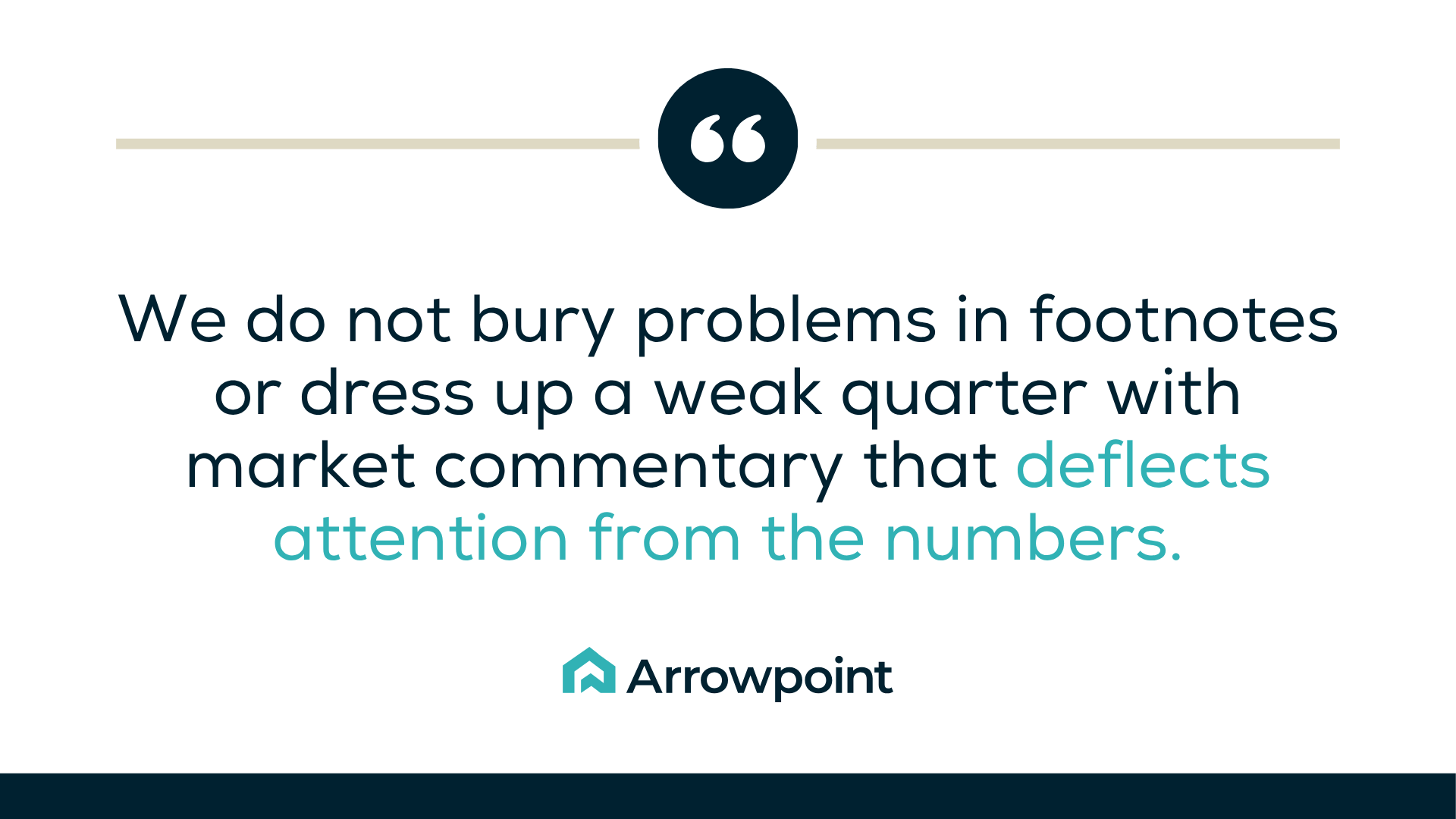
Our quarterly reports are written for people who are busy and who want clarity. We do not bury problems in footnotes or dress up a weak quarter with market commentary that deflects attention from the numbers. If occupancy dropped, we say why and what we are doing about it. If a renovation is running behind schedule, we say that too.
My father taught me early on: here is the issue, here is the solution. That framing shapes every report we send. Investors are not looking for a press release. They are looking for evidence that we are on top of things and that we will tell them when we are not.
Distributions and the Logic Behind the Timing
We calculate distributions at the end of each quarter and get them out to investors before the quarterly report. The goal is to put money in accounts first, then explain the context. Most investors, when they see distributions arriving consistently, read the report with less anxiety. The numbers matter. So does the order.
In 22 years, we have deferred distributions only once. That was in the spring of 2020, in the first weeks of COVID, when nobody in this industry could say with confidence what was about to happen to rent collections, courts, or the economy. We held cash briefly, communicated the reason directly, and resumed normal distributions as quickly as the picture clarified. That is the only time it has happened.
K-1s by the End of February
Late K-1s are one of the most common frustrations in private real estate investing. They hold up personal tax filings, force extensions, and create unnecessary friction between investors and sponsors.
We use the same CPA firm we have worked with for more than 12 years. They know our deal structure, they know our investor base, and they prioritize getting returns filed well ahead of the federal deadline. Investors typically receive their K-1s by the end of February. We are aware this is not standard in the industry. It requires coordination and it requires a firm that treats the deadline as a commitment rather than a guideline. Ours does.
We cover the questions investors should be asking in What Investors Get Wrong Before Committing Capital.
Direct Access to the Decision-Maker
After 22 years, I still give out my cell phone number to investors. Most do not use it - usually it is an email about a K-1 or a question on the quarterly report. But the access matters. When the deal is going well and distributions are arriving on time, most investors do not need much from us. When something happens, they want to know they can get to the person who is actually making decisions, not a relationship manager reading from a script.
That is a function of size and of how we run the business. We are not structured to insulate the principal from investors. We are structured so the principal is accountable to them directly.
What Investors Actually Ask About
The most common questions we get are administrative: K-1 timing, distribution dates, questions about a line item on the quarterly financials. Occasionally an investor will want to understand a decision we made on a property - a capital project we accelerated, a lease-up we extended, a renovation scope we adjusted. We welcome those questions. They are a sign of engagement, and they give us a chance to explain our thinking.
What we cannot do is provide individualized analysis on demand for every investor in every deal. We have an obligation to the whole LP group to spend our time managing the assets. The quarterly reports are designed to answer the questions that come up most often. If something beyond that is needed, we address it directly.
How We Handle Periods When Things Are Not Going to Plan
Every deal has quarters that disappoint. Markets move, costs surprise, tenants cause problems, projects run long. The question is not whether something will go wrong - it will - but how the sponsor handles it when it does.
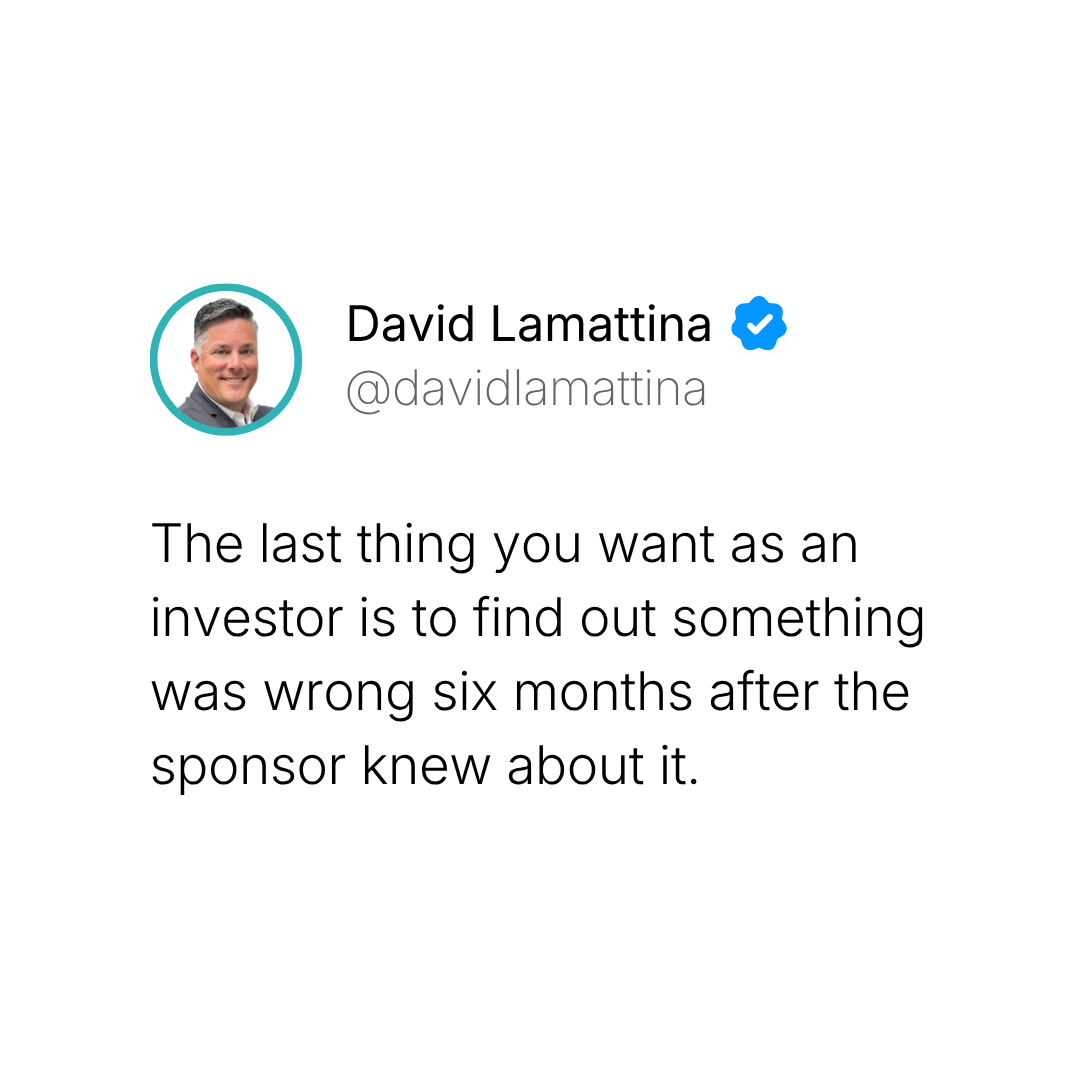
Our approach is straightforward: we tell investors what happened, what we think caused it, and what we are doing about it. We do not hide problems to protect the optics of a quarterly report. The last thing you want as a sponsor is for an investor to find out something was wrong six months after you knew about it. Trust is hard to rebuild once it is broken that way.
This applies to the deals we are proudest of and to the ones that have tested us. The Worcester properties - three brick buildings we acquired from long-term family ownership that had under-invested for years - had significant deferred maintenance and required a full exterior rehabilitation. We communicated the scope, the cost, and the timeline before the work started, and we updated investors as the project moved forward. That kind of transparency is not a communications strategy. It is just how a functional business relationship works - and it is what I write about in What Keeps Me Up at Night.
Vetting Goes Both Ways
The industry spends a great deal of time discussing how investors should vet sponsors. They should - rigorously. But the conversation rarely acknowledges the inverse: sponsors have an obligation to vet the investors they bring into deals.
A disruptive investor is not just a problem for the sponsor. Legal and administrative costs generated by investor disputes are borne by the deal entity - which means the other LPs absorb them. We learned this the hard way. A referred investor who seemed straightforward turned out to be a serious problem. The matter went to arbitration. We prevailed completely, but the legal fees, the time, and the stress were real. I told my lawyer at the time that every week it continued was a little bit off my life. That is not an exaggeration.
The lesson was not that referrals cannot be trusted - our investor base has been built entirely through referrals over 22 years, and the vast majority of those relationships have been excellent. The lesson is that no referral source is a substitute for paying attention to how a prospective investor communicates and what they expect. If someone is asking the same question in five different ways before the subscription closes, that tells you something about what the relationship will look like inside the deal.
Every investor who comes into an Arrowpoint deal goes through SEC mandated accreditation verification and standard AML/KYC/OFAC compliance. Beyond that, we rely on judgment and on the signal quality of the referral relationship. We are selective. The investor base we have built reflects that. You can learn more on our about page.
Why Most of Our Investors Come Back
We have investors who have been in deals with us since inception. Some have been in four or five syndications. A number have referred colleagues, friends, and family members. That pattern - an investor who likes a deal well enough to bring someone else in - is the clearest evidence we have that the relationship is working.
The reason people come back is not any single factor. It is the combination of consistent execution, transparent communication, and a sense that the sponsor is actually paying attention to the asset. Our deals have performed well - 32% average net IRR and a 2.50x equity multiple across realized deals - but track record alone does not explain 10-year relationships. Those are built on something more fundamental than return figures.
We are not the right fit for every accredited investor. We do not offer a high volume of deals - we are selective about what we buy, and we buy within a market we know cold. Some investors want more optionality, or a larger platform, or a product they can invest in passively without ever thinking about the market specifics. We are not that. We are a concentrated, relationship-first operator with a 22-year track record in one geography, and the investors who fit that model tend to stay - which is exactly what I describe in Don't Expect a Ton of Deals From Us.
What the Arrowpoint LP Experience Looks Like Deal by Deal
For investors who have not been in an Arrowpoint deal before, here is a practical picture of what the experience looks like from the day you commit to the day we exit.
Before the Deal Closes
You will receive a private placement memorandum, a subscription agreement, and access to deal materials. We walk through the investment thesis, the business plan, and the risks. We answer questions directly. We do not use the pre-closing period to sell; we use it to make sure you understand what you are committing to.
During the Hold Period
Quarterly distributions, quarterly reports, and direct access to us if something comes up. If the property is going through a significant renovation - which it often is in the first one to two years of a value-add deal - we communicate project milestones, costs, and schedule. You will not wonder what is happening on the asset because we do not leave that vacuum.
At Exit
When we sell, we return capital and distribute proceeds with a full accounting of the waterfall. You will receive a clear breakdown of your return - principal returned, preferred return paid, and equity split. We do not complicate the mechanics of a distribution at exit.
What we do not do is guarantee a specific exit timeline. We underwrite for five-year holds but we will not sell to hit a date if the market does not support it. Holding when offers are on the table is not comfortable. It is right when the asset has more to give - a lesson I cover in detail in I Sold Too Early - and What It Cost.
Frequently Asked Questions
How often does Arrowpoint communicate with investors?
Quarterly distributions and quarterly written reports are the standard cadence. Beyond that, we communicate when something material happens - a major construction milestone, a significant market development, anything we think investors need to know about before the next report cycle. We do not send communications for the sake of activity, but we do not hold back information that matters.
What is the minimum investment in an Arrowpoint syndication?
Minimums vary by deal. Our closed-end fund, AMFI, had a minimum commitment of $250,000, structured as capital calls over a four-year investment period rather than a lump sum at closing. Minimums for individual deal syndications vary - prospective investors should ask about the specific opportunity they are considering.
How does Arrowpoint handle deals that underperform projections?
We address it directly in the quarterly report and in any additional communication warranted by the situation. We explain what changed, what we are doing about it, and what the revised outlook looks like. We do not run from bad news. The investor relationship depends on credibility, and credibility depends on honesty about performance - not just when deals are going well.
Does Arrowpoint accept investors from outside the Merrimack Valley?
Yes. Our investor base has grown primarily through referrals from existing investors, and those networks extend well beyond the immediate geography. What we require is accreditation - we operate under Regulation D - and the standard compliance documentation. Location is not a limiting factor.
What happens if I need liquidity before the hold period ends?
Syndication investments are illiquid by structure. There is no redemption mechanism and no secondary market for most Arrowpoint deals. We are clear about this upfront because it is fundamental to the investment. Investors should only commit capital they are comfortable holding for the projected hold period, which is typically five to seven years. We do not offer early exit options, and investors should not invest in private real estate with capital they may need access to.
Learn More About Investing with Arrowpoint
Investors considering an Arrowpoint deal can explore the links below to understand our market thesis, our underwriting approach, and the track record behind the returns.
Investors considering an Arrowpoint deal can learn more about the market we operate in from The Merrimack Valley Investment Thesis, how we evaluate and price acquisitions from How We Underwrite Multifamily Deals, and the track record behind the returns from 26 Syndications, No Capital Loss.
To discuss a current offering or ask questions about the investor relationship at Arrowpoint, contact us directly through the Arrowpoint Properties website.

David Lamattina
President & CEO
About Dave Lamattina
Dave Lamattina is the founder and CEO of Arrowpoint Properties, a vertically integrated multifamily owner-operator based in Lawrence, Massachusetts. He has been acquiring and operating multifamily assets in the Merrimack Valley for over 22 years, with 1,100+ units acquired and exited and a current portfolio of approximately 850 units valued at around $230 million. Arrowpoint has completed 26 syndications with an average net IRR of 32% and a 2.50x equity multiple.