Underwriting a multifamily deal means stress-testing every assumption that stands between your capital and a bad outcome. At Arrowpoint Properties, that process runs on three fixed rules: renovation dollars must return at least 15-20% in year one, debt must be fixed-rate and non-recourse at 70-75% LTV with a minimum five-year term, and the business plan must survive being held through a down market without a capital call. In 22 years and 26 syndications across the Merrimack Valley and New England, those rules have never produced a loss of investor capital or missed distribution.
Key Takeaways
- The renovation return threshold is 15-20% in year one. If spending $15,000 per unit does not produce at least $200/month in additional rent, the renovation does not get approved. That math is harder to hit today than it was five years ago, and it has changed which deals Arrowpoint pursues.
- Debt structure is the first line of defense against a bad market. Fixed rate, non-recourse, agency preferred, minimum five-year term. No bridge loans. No floating rate. The sponsors who hit the wall in 2022-23 were mostly running bridge debt on deals that needed things to go right. Arrowpoint underwrites assuming things will go wrong.
- Staying power is not a slogan. It is a specific set of decisions made at acquisition: enough equity cushion, the right debt term, a business plan that does not depend on a sale at year three. Dick Goldberg, Dave Lamattina's mentor on the North Shore, built a multigenerational portfolio on that principle, buying properties in 1972 and 1975 that his family still holds.
- Rent growth assumptions are currently 0-2.5%. Arrowpoint does not underwrite to optimistic rent growth. At current market conditions, models run at flat to minimal growth, with cap rate expansion assumed at exit rather than compression.
- The business plan has to survive a five-year hold without a forced exit. If the model only works with a sale at year two or three, it does not pass underwriting. Exit timing should be opportunistic, not obligatory.
- Class B/C workforce housing changes the risk profile at the foundation. Vacancy in Lawrence sits around 1.4%. Demand from working-class renters does not disappear in recessions - it tends to increase. That structural floor is part of the underwriting thesis, not an afterthought.
Dave Lamattina has been acquiring and operating multifamily in the Merrimack Valley since 2004. Arrowpoint Properties has completed 26 syndications with an average net IRR of 32% and a 2.50x equity multiple. No investor has lost capital across those deals. The underwriting framework described here is drawn directly from Lamattina's operating experience - not from textbooks. For a deeper look at how Arrowpoint structures investor relationships, read the story of Arrowpoint's first LP.
Subscribe to our educational newsletter and join the priority waitlist for our next offering

What Underwriting Actually Does
The word ‘underwriting’ can sometimes get used loosely. In practice, underwriting a multifamily deal is the process of determining whether the assumptions built into a pro forma are defensible - and what happens if they are not.
A pro forma is a structured set of calculated projections. Underwriting is the discipline that forces you to confront what each calculation costs if it misses. Most sponsors underwrite to the case they are trying to make. The ones with long track records underwrite to the case they are afraid of.
At Arrowpoint, the process starts with three questions. What does the debt cost, and what does it do to cash flow if nothing else goes right? What does the renovation program have to return to justify the capital, and is that return achievable at current rents? And what does the deal look like at year five if the market has not cooperated?
If all three questions have defensible answers, the deal moves forward. If any one of them does not, it does not.
The Debt Decision
The way debt is structured is the most consequential decision in any acquisition, and it is the one most likely to be underweighted when a market is moving fast.
Arrowpoint's standard is fixed-rate, non-recourse financing at 70-75% LTV with a minimum five-year term. Agency debt - Fannie Mae or Freddie Mac - is preferred when available. Bridge loans are not used. Floating-rate debt is not used.
The reasoning is straightforward. Bridge debt works when everything goes according to plan: the renovation gets done on schedule, rents move to pro forma, and the property refinances cleanly. In a market that cooperates, bridge debt looks smart. In a market that does not, it can become the mechanism that forces a distressed sale.
The 2022-23 rate environment demonstrated this at scale. Sponsors running floating-rate bridge debt on value-add deals found themselves with debt costs that had reset sharply, renovation programs that were not yet generating income, and no clear path to a refinance that penciled. Some of those deals required capital calls. Some required distressed sales. Arrowpoint had none of those problems, because the debt structure had been designed around the assumption that the market could move against the deal.
The five-year minimum term matters for the same reason. A 5-7 year fixed-rate loan on a well-underwritten deal means Arrowpoint can hold through a down market, complete the renovation program without time pressure, and exit when conditions are favorable rather than when the loan matures. The debt does not dictate the exit.
Yield Maintenance and Opportunistic Exits
Fixed-rate agency debt comes with yield maintenance provisions - prepayment penalties that compensate the lender for the interest it would have earned if the loan ran to term. Those penalties can be substantial.
In 2016, Arrowpoint closed River's Edge, its first large deal, with 7-year Fannie Mae financing. Three years into the hold, the same broker who sourced the deal brought an offer that was too good to refuse. The yield maintenance penalty came to almost $1.5 million. We paid it. The deal still returned 32% net IRR to investors.
The lesson is not that yield maintenance is costless - it clearly is not. The lesson is that fixed-rate debt does not prevent an early exit when the numbers justify one. It just requires that the exit price be high enough to absorb the cost. That is a reasonable constraint, and it prevents the reflexive early exits that leave money on the table.
The Renovation Return Threshold
Every unit renovation at Arrowpoint has to clear a return hurdle before it gets approved: 15-20% return on renovation dollars in year one.
The math is straightforward. If the renovation costs $15,000 per unit, the rent premium has to be at least $200 per month - $2,400 annually - to hit the floor of that range. That is a 16% return on the renovation investment in the first year, before any consideration of what that premium does to exit value.
That threshold has not changed. What has changed is how hard it is to hit.
Why the Math Is Harder Now
Five years ago, a $15,000 renovation could reliably produce $200-250 per month in rent premium in Arrowpoint's core markets. Construction costs have risen materially since then. Labor is more expensive. Materials cost more. A renovation that would have run $12,000 per unit in 2019 might run $18,000-20,000 today.
At the same time, rent growth in workforce housing has flattened relative to the pace of the prior cycle. The working-class tenants in Lawrence, Methuen, and Haverhill have limited ability to absorb rent increases beyond what their incomes support. That ceiling is structural, not cyclical.
The result is that the heavy value-add business plan - buy a distressed property, renovate aggressively, reposition the rents - is harder to execute profitably at current costs than it was in 2018 or 2019. Arrowpoint's response has been to adjust the deal profile rather than lower the threshold. The firm has moved toward 2000s-vintage Class B assets, like the 2009-built Elora acquisition, where the renovation requirement is lighter, the immediate cash flow is stronger, and the 15-20% return on renovation dollars is achievable without an aggressive rent assumption.
The threshold is not negotiable. The deal type has to fit the threshold, not the other way around.
What Renovation Return Means for Exit Value
The 15-20% return threshold is a year-one cash test, but its implications extend to exit. A renovated unit producing $200-250 per month in additional rent does not just add to current cash flow - it creates a permanent income stream that buyers capitalize at exit.
At a 5.5% cap rate, $2,400 in additional annual net operating income per unit adds roughly $43,600 in value. On a 50-unit renovation program, that is more than $2.1 million in created value against a renovation spend of $750,000 - before any market appreciation. That math is what makes a well-executed value-add program durable: the value is created by income, not by the market.
Arrowpoint renovated close to 50 units at Appleton Square in Methuen to ‘condo quality’ - quartz countertops, blown-out kitchens, new cabinets, lighting, and flooring. The property was bought for under $30 million. Before being pulled from the market, offers had come in between $40 million and $42 million. The renovation program was the difference.
Stress Testing the Business Plan
Arrowpoint runs multiple pro forma scenarios, not one. The base case is not the only case examined.
The stress test starts with rent growth. Current underwriting assumes 0-2.5% annual rent growth. That is a floor assumption. If the deal does not work at that growth rate, it does not work.
The next lever is the expense ratio. If the model projects a 40% expense ratio, the stress test runs it at 45-50%. Insurance costs in New England have moved sharply in recent years. Energy costs are volatile. Labor for maintenance is more expensive than it was. A deal that only pencils at tight expense assumptions is a deal that is already in trouble.
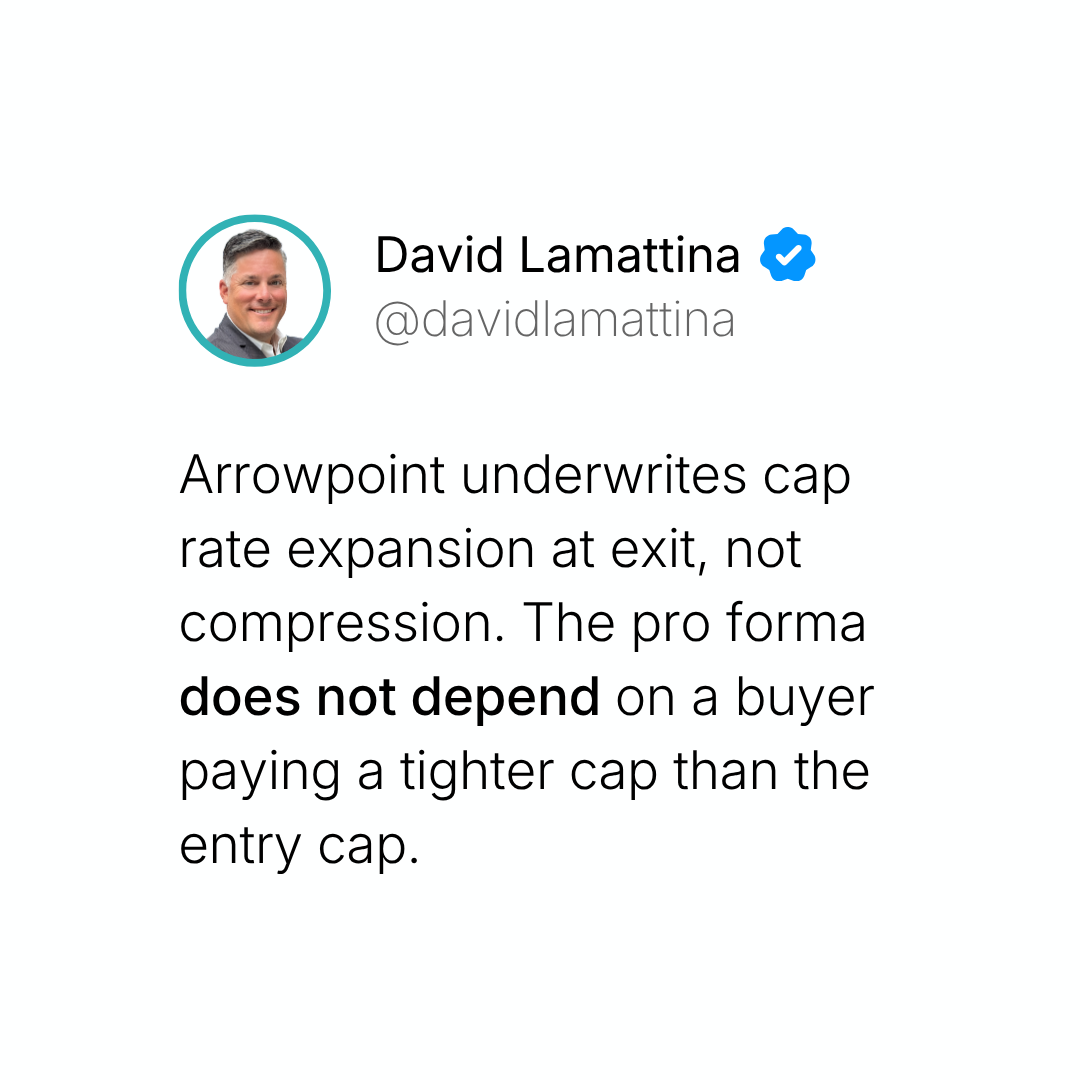
On exit, Arrowpoint assumes cap rate expansion, not compression i.e. that prices soften overall, vs. going up over the hold period. The pro forma does not depend on a buyer paying a tighter cap than the entry cap. If the market moves against the exit, the deal has to survive that scenario without requiring a distressed sale.
Taken together, these assumptions produce a model that is harder to make work than a typical sponsor's base case. That is the point. A deal that passes Arrowpoint's stress test has already survived a version of the bad scenario on paper. It has not been made bulletproof - no deal is - but the possible risks have been priced in.
What the Model Does Not Control
Lamattina is clear that underwriting cannot eliminate all risk. Political risk is real: a statewide Massachusetts rent control ballot initiative, with 62.6% voter support in polling as of mid-2026, would materially change the NOI outlook for properties in the middle of a value-add program. Economic conditions change. Interest rates move. Insurance markets shift.
The response to uncontrollable risk is the same as the response to controllable risk: staying power. If the debt is fixed and long-term, if the equity cushion is adequate, if the business plan does not require a sale to recover capital, then Arrowpoint can hold through whatever the market produces. That is the principle Dick Goldberg passed down, derived from 50 years of owning property in the same geography through every cycle that came through.
Staying Power: The Principle Behind the Numbers
Dick Goldberg grew up in a real estate family on the North Shore of Massachusetts. When Dave Lamattina met him in the early 2000s, Goldberg took him out in his pickup truck and drove him around the properties his family had been acquiring since 1972. “That one I bought in '72. That one's been in the family since '75.”
The families that had sold along the way - the ones who needed liquidity, or who had taken on too much debt, or who had built business plans that required a benign market - were gone. The Goldbergs were still there.
"You have to have staying power," Goldberg told Lamattina. "You have to be able to outlast downturns, down markets, and everybody else." The operators who can weather the storm are the ones who last. The ones who are still in the game at the end of every cycle are the ones who structured their deals to survive being wrong.
That experience and mentorship On to the next one. All right. 306. Thank you. About 15. Okay. is the foundation of Arrowpoint's underwriting philosophy. The specific rules - 70-75% LTV, fixed rate, minimum five years, 15-20% renovation return threshold, 0-2.5% rent growth assumption - are all expressions of the same underlying principle. Structure the deal to survive the bad scenario, and the good scenario will take care of itself.
Lamattina drove to Goldberg's office through a February blizzard in a two-wheel drive sedan for their first meeting. Goldberg told that story for years afterward. "This kid must be motivated." The discipline that followed that meeting has been the consistent thread across 26 syndications and two decades of New England real estate cycles.
How Deal Type Affects Underwriting Targets
Not all Arrowpoint deals are underwritten to the same return targets. The targets shift based on deal type, risk profile, and business plan intensity.
Older value-add deals - typically 1960s-70s vintage Class C workforce housing requiring significant renovation - carry a target IRR of 18-22% with a minimum 6% year-one cash-on-cash return. The renovation program is more intensive, the execution risk is higher, and the return target reflects that.
Core-plus and newer-vintage assets - 2000s vintage Class B properties like Elora, a 2009-built 104-unit property acquired for over $30 million - carry a lower IRR target of 15-16%, again with a minimum 6% cash-on-cash. The renovation requirement is lighter, cash flow is immediate, and the business plan is less dependent on successful execution of a heavy renovation program.
Equity multiple targets are 2.0x at minimum, with stronger deals targeting 2.5x. These are not the numbers a deal is marketed on - they are the numbers it has to clear before the decision to proceed is made.
The shift toward newer vintage is partly a response to construction cost inflation making the heavy value-add threshold harder to hit, and partly a response to what we see in the investor base: more appetite for immediate cash flow and a lighter execution risk profile than for the maximum IRR a heavy value-add can theoretically produce.

The Exit Decision
Arrowpoint underwrites for a five-year hold. That does not mean every deal is sold at five years. It means every deal is structured to be holdable for five years without requiring a sale.
When the deal is right, Arrowpoint exits early. River's Edge was sold at year three with a $1.5 million yield maintenance penalty and still returned 32% net IRR. Appleton Square had offers between $40 million and $42 million before Lamattina pulled it from the market - an indication that the exit timing did not match the business plan, not that the deal was not ready.
If Lamattina had his way, he says he would never sell anything. The decision to sell is always a tension between the returns available today and the income stream that would continue if the property were held. The answer changes deal by deal. The constant is that the sale is never forced.
That optionality is built in at acquisition. A deal structured with adequate equity, appropriate fixed-rate debt, and a business plan that does not require a particular exit window gives the operator the ability to hold or sell depending on conditions, not depending on what the lender or the loan maturity requires. That is staying power in practice.
Applying the Framework
The Arrowpoint underwriting framework is not proprietary, and it is not complicated. It is a set of disciplines, applied consistently over 22 years, that have produced 26 consecutive syndications with consistent distributions and without a loss of investor capital.
The renovation return threshold keeps capital allocated to projects that justify the spend. The debt rules keep the capital structure from becoming a liability when markets move. The stress-test assumptions keep the business plan honest about what it needs to work. And the staying power principle connects all of them to a long-term operating philosophy that treats downturns as a condition to survive, not a reason to sell.
For investors evaluating a multifamily sponsor, the underwriting framework is one of the most direct windows into how the firm thinks about risk. A sponsor who can describe their renovation return threshold, their debt constraints, and their stress-test methodology in concrete numbers is a sponsor who has actually done the analysis. A sponsor who speaks only in range of return and general principles probably has not.
The deals in the Arrowpoint track record were all underwritten this way. The framework did not guarantee the outcomes. It created the conditions for them.
Frequently Asked Questions
What is the minimum cash-on-cash return Arrowpoint targets in year one?
Arrowpoint targets a minimum 6% cash-on-cash return in year one across both its value-add and core-plus deal types. That floor applies regardless of the overall IRR target for the deal. A deal projecting strong long-term returns but weak current cash flow raises questions about how the business plan is structured and whether it requires events - rent growth, appreciation - that are not yet in evidence.
Why does Arrowpoint use fixed-rate agency debt instead of bridge loans?
Bridge debt is designed for deals where execution needs to happen on a defined timeline before the loan comes due. If the renovation program runs long, if rents do not move as projected, or if the refinance market tightens, a bridge loan creates pressure to act - to sell, to raise equity, to extend at punishing rates. Fixed-rate agency debt removes that pressure. The five-year minimum term means Arrowpoint can hold through a down market without a forced decision. The 2022-23 rate environment demonstrated what happens to bridge-financed deals when the market moves against the plan.
How does Arrowpoint decide how much to spend on a unit renovation?
The renovation budget is set during due diligence and is tested against a 15-20% return threshold before the deal closes. If the projected rent premium at market rents does not produce at least that return on the renovation spend in year one, the budget is adjusted or the deal does not proceed. At current construction costs, that threshold is harder to meet than it was five years ago, which is part of why Arrowpoint has moved toward newer-vintage assets that require a lighter renovation lift. The 15-20% Rule covers this framework in detail.
What rent growth does Arrowpoint assume in its underwriting?
Current underwriting uses 0-2.5% annual rent growth. That reflects current market conditions in the Merrimack Valley, where meaningful rent growth in Class B/C workforce housing is constrained by tenant incomes, and where a Massachusetts statewide rent control initiative is a realistic regulatory risk for the next ballot cycle. Conservative rent growth assumptions force the deal to be underwritten on current income, not on projected income that has not yet materialized.
What happens to an Arrowpoint deal in a recession?
The short answer is that workforce housing performs better in recessions than Class A does. Demand from working-class renters tends to increase when economic pressure pushes higher-income households down the rental stack. The vacancy rate in Lawrence - Arrowpoint's core market - sits around 1.4%, a level that has been persistent across cycles. More important than the market response, though, is the deal structure: fixed-rate debt with no maturity cliff, adequate equity, and a business plan that does not require selling at a particular time means Arrowpoint can hold through the cycle and exit when conditions are favorable. Staying Power covers the philosophy behind that approach.

David Lamattina
President & CEO
About Dave Lamattina
Dave Lamattina is the founder and CEO of Arrowpoint Properties, a vertically integrated multifamily owner-operator based in Lawrence, Massachusetts. He has been acquiring and operating multifamily assets in the Merrimack Valley for over 22 years, with 1,100+ units acquired and exited and a current portfolio of approximately 850 units valued at around $230 million. Arrowpoint has completed 26 syndications with an average net IRR of 32% and a 2.50x equity multiple.