Class B/C multifamily operations reward hands-on ownership and operational excellence. Older workforce housing - typically 1960s to 1990s garden-style buildings - offers opportunities to create value through attentive management, proactive maintenance, and strong tenant relationships. Owners who stay close to their properties can identify needs early, preserve asset quality, control operating costs, and improve resident satisfaction. The operators who consistently outperform in this segment are those who understand the property, the tenant, and the building systems well enough to address opportunities before they require significant intervention.
Key Takeaways
- Dave Lamattina built his management operation - leasing, maintenance, legal, accounting - before he ever raised outside capital. That sequence is rare and it is the foundation of everything Arrowpoint does differently. Property management comes first.
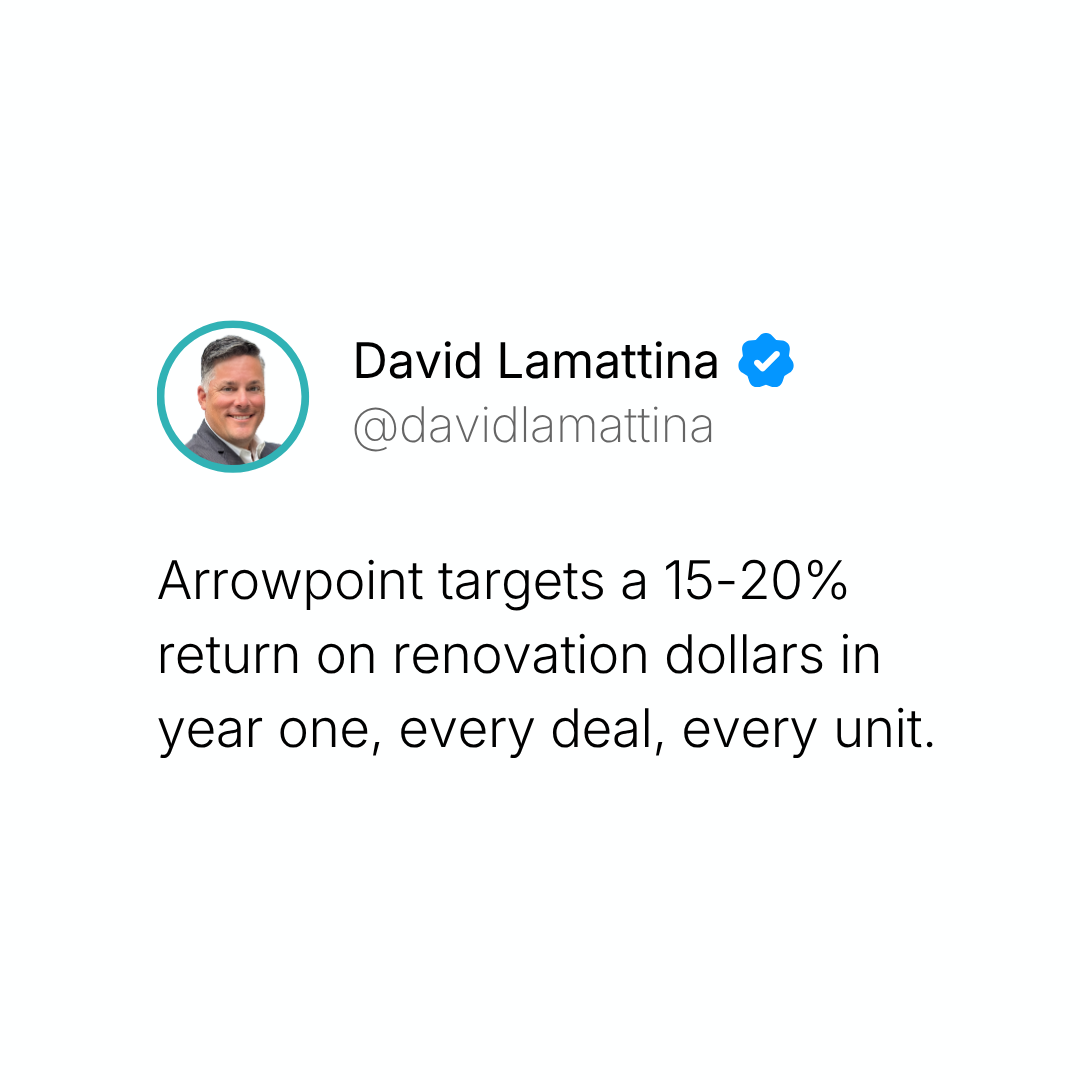
- Arrowpoint targets a 15-20% return on renovation dollars in year one. Spending $15,000 per unit requires a rent premium of at least $200 per month to clear that hurdle. Renovation math has a specific threshold.
- Class C assets built in the 1960s and 70s carry higher maintenance intensity and more capital uncertainty. They also carry higher return potential - when the operator knows what they are getting into before they close. Older vintage demands more but offers more.
- A Property Condition Report is a starting point, not a guarantee. Budget discipline on workforce housing means assuming surprises and reserving for them, not hoping the PCR caught everything. Inspections miss things.
- Arrowpoint's Merrimack Valley portfolio runs at roughly 98% occupancy even as collections become more complex. The reason is straightforward: take care of residents, reduce turnover, and reduce the vacancy-driven maintenance expense that kills cash flow on older properties. Occupancy holds - if you take care of tenants.
- Arrowpoint is adding 2000s-vintage assets alongside its core older portfolio. Lighter lift, lower risk, immediate cash flow. The older product still works for the right deal at the right basis. The shift to Class B is real but selective.
Dave Lamattina has been acquiring and operating workforce multifamily in the Merrimack Valley for more than 22 years. He started with a single four-family building, did the maintenance himself, and built a property management operation from the ground up before he raised his first dollar of outside capital.
Today Arrowpoint Properties manages approximately 850 units across 26 syndications, averaging a 32% net IRR and a 2.50x equity multiple across all realized deals, with no loss of investor capital. The operational knowledge behind those numbers was not purchased from a third-party manager. It was built one property at a time, by the team behind Arrowpoint Properties.
Subscribe to our educational newsletter and join the priority waitlist for our next offering
Property Management First: The Sequence That Separates Operators from Sponsors
Most real estate syndicators start with capital formation. They find a deal, raise money, then figure out how to run the asset - often by hiring a third-party property manager and hoping the numbers hold.
Dave Lamattina did it in the opposite order.
His first property was a four-family in Lawrence, Massachusetts, purchased in 2004. He could not afford to pay contractors, so he did the maintenance himself. He changed toilets and faucets, did the painting, learned the plumbing. When he eventually decided to scale into syndications around 2008 and 2009, he already understood the business from the inside out - leasing, accounting, maintenance scheduling, and the legal side of tenant relations.
"I would say we're property management first," he has said. "I didn't discover syndications and private equity till later. I know all aspects of that business because I learned it myself. From leasing to accounting to maintenance and the legal aspect of it."
That sequence matters for investors in a way that is rarely discussed directly. A sponsor who has never personally managed a property is underwriting someone else's execution. Everything depends on the third-party manager performing - on their staffing, their maintenance relationships, their collections process, their response time when a boiler fails at 11pm on a Friday in February.
Arrowpoint's management is entirely in-house. The corporate office runs leasing, maintenance, and operations across the portfolio. The regional manager, property managers, leasing agents, and maintenance team are all Arrowpoint employees. When something goes wrong on a property, it lands on Dave's desk - not in a support ticket queue at a third-party firm.
The staffing approach is straightforward. Industry standard is one full-time administrative person and one full-time maintenance technician per 100 units. Arrowpoint runs roughly that ratio across its portfolio. The Worcester assets - three brick buildings totaling approximately 270 units - run with two full-time maintenance and two full-time administrative staff managing the combined portfolio, supplemented by subcontractors for specialized work. The Merrimack Valley smaller-building portfolio, clustered around Lawrence, Methuen, and Haverhill, is managed from the corporate office with dedicated leasing, management, and a maintenance team of four to five people.
Subcontractors handle the work that requires licenses and permits - electrical panels, boiler replacements, major plumbing. The in-house team handles daily work orders, unit turns, and routine maintenance. That division is intentional. Keeping routine maintenance in-house controls costs and response time. Keeping licensed specialty work with established subcontractors keeps quality consistent.
How Arrowpoint Underwrites Renovation Spending
The renovation threshold at Arrowpoint is a formula.
Any capital spent on a unit renovation needs to return 15-20% in year one. That means if the budget is $15,000 per unit, the renovation needs to generate at least a $200 per month rent premium - $2,400 annualized, which is a 16% return on the capital deployed.
"We look at more of the individual unit, and what we have to spend, and then what's the premium we're going to obtain," Dave has explained. "If we're spending $15,000, we need to see at least a 15% return in that first year."
This framework answers the question before it gets asked: does it make sense to renovate this unit? Look at comparable finished units in the market, set a realistic ceiling on achievable rent, work backward from the threshold, and determine how much renovation budget the economics can support.
For Class C assets - 1960s and 70s vintage buildings in rough condition - that renovation scope is often significant. Quartz countertops, new cabinets, full kitchen layouts, luxury vinyl plank flooring, recessed LED lighting. The same unit that was renting at $900 per month unrenovated can lease at $1,200 or more after a quality renovation - if the surrounding comps support it.
For newer Class B assets, the calculus looks different. A light lift - new flooring, updated appliances, some lighting upgrades - at $5,000 to $8,000 per unit, requires a smaller rent bump to clear the threshold. The risk of not hitting the number is lower because the gap to close is smaller.
The renovation scope is determined during due diligence. Arrowpoint walks units and common areas with its own team, not just an inspector. They compare against active listings in the same submarket to establish where market rents are right now - not where they were six months ago. That comparison determines what the property needs to be competitive and what the ceiling on rent premium realistically is.
Once closed, execution starts immediately. Vacant units go into renovation on day one. Common areas get updated in parallel. Amenity improvements - if planned - are sequenced to minimize disruption. Having established vendor relationships with painters, flooring contractors, and appliance suppliers shortens the timeline and controls pricing. Arrowpoint's volume relationship with Sherwin-Williams covers paint and flooring at contract pricing. Their commercial account at a regional Lowe's has, at points, made them one of the largest commercial customers in New Hampshire.
Related case study: One Step Away From Condemned, the Worcester before-and-after.
The Tenant Dynamic in Workforce Housing - and Why 98% Occupancy Holds Anyway
Collections are more complicated than they were five years ago. The pandemic created a set of conditions - state assistance programs, moratorium-era habits, an expanded sense of what tenants could access without consequence - that have not fully unwound.
Massachusetts's tenant assistance programs make money available with minimal hardship requirements. A tenant who decides not to pay rent can access funds to cover back rent without necessarily demonstrating genuine inability to pay. That creates a dynamic that did not exist before 2020: more legal cases, more collections friction, and a legal process that moves slowly.
"We're finding a lot more cases where people are running into the issue of not being able to make rent, and it's causing our legal cases to increase - where in the past, we never had that issue," Dave has said. "That really stemmed from the pandemic. Things got put in place, and they kind of stuck."
At the same time, Arrowpoint's Merrimack Valley portfolio sits at roughly 98% occupied. Collections overall are strong. The reason is the market itself: vacancy in Lawrence runs around 1.4%, demand is persistent, and tenants who do leave are replaced quickly. Workforce renters in the Valley are not seasonal - they live, work, and put down roots here.
The operational implication is straightforward. Keep occupancy high by keeping residents. Keep residents by taking care of properties. A resident who sees money being spent on their building, who gets responsive maintenance, who lives somewhere that does not embarrass them - that resident renews. Turnover is expensive. Every vacant unit costs money in lost rent, make-ready costs, and leasing expense. Reducing turnover is not just good landlording. It is the most direct path to controlling operating costs on an older building.
"You take care of your residents, you're going to reduce your turnover, and if you reduce your turnover, you're going to reduce your maintenance expense - which can get out of control the more vacancy you have," Dave has explained.
The collection challenge is real and it is being managed. The occupancy number at 98% tells its own story about the demand side of the equation - the dynamic behind The State Cut a Check and Nobody Needed It.
Capital Planning on Aging Assets: The Things Inspections Don't Find
A Property Condition Report is a professional assessment of a building's current condition. It is performed in a limited timeframe by an independent inspector and it acts as a starting point.
Experienced operators treat it as such.
Things get missed. That is a given. HVAC systems that appear functional may have components that fail within a year of closing. Drainage issues buried underground do not show up on a visual inspection. Life safety items - fire alarm systems, structural concerns with exterior features like decks or balconies - may not be apparent without invasive testing.
On one recent acquisition, Arrowpoint discovered after closing that a portion of the HVAC system was not functioning as disclosed. The previous owner had known about the issue and chose not to address it. It was not in the PCR. "There's always going to be stuff that gets missed. It's just a given," Dave has noted.
The response is to fix it. Arrowpoint's operating standard is that if something is supposed to be working, it gets made to work. That is a maintenance and risk management position. Non-functioning systems create liability, create board of health exposure, and create the kind of resident dissatisfaction that produces turnover.
The harder version of this problem is the ongoing capital requirement of aging stock. Class C buildings built in the 1960s and 70s are now 50 to 60 years old. Boilers age. Windows fail. Parking lots crack. Roofs reach end of life. When multiple systems hit the replacement cycle in the same period and cash flow is tight, the operator has to triage: what is a no-choice item and what can wait?
Heating and cooling are no-choice items. A tenant without heat in a Massachusetts winter creates an emergency, a health code violation, and potentially a habitability claim. When an HVAC unit fails, it gets replaced - regardless of timing, regardless of cash flow pressure. Health and safety code violations are no-choice items. Legal exposure on deferred structural issues is a no-choice item.
Everything else gets evaluated. The capital planning process at Arrowpoint starts during underwriting - reserves are sized based on a realistic assessment of what the building will need, not a generic percentage of revenue. After years of managing older stock, the team has a feel for the failure curve of mechanical systems, roofing, and exterior components that does not come from a spreadsheet.
Related reading: What Inspections Don't Find - drainage problems, HVAC discoveries, and how to budget for the unknown.
Why Arrowpoint Is Adding Class B Alongside Its Core Portfolio
The older Class C business model - heavy value-add, 1970s vintage, significant renovation budget, 18-month to 24-month stabilization period before meaningful distributions - still works. But it has become harder.
Construction costs have gone up. Rent growth has moderated. The risk profile on a property that requires a $20,000 per-unit renovation program is higher when costs can run over budget and rent premiums are harder to achieve than they were in 2021.
Investor appetite has also shifted. Most LP capital today wants cash flow in year one. Heavy value-add deals, where distributions may not start for 18 to 24 months, have become harder to fill. The same dollars that would have gone into a 22% IRR value-add deal are now looking for 15-16% on a stabilized asset that starts paying in quarter one.
"Investors want a lower risk profile kind of deal that is somewhat stabilized already and is going to offer cash flow from day one - that's mostly what they want right now," Dave has said. "The consensus is people want cash flow, they want it in year one, and they want a relatively safe investment."
Arrowpoint's response has been to add 2000s-vintage Class B assets to the acquisition pipeline alongside its traditional Class C focus. The Elora acquisition - a 104-unit, 2009-build asset in Lawrence at over $30M - is the flagship of that shift. Two earlier closes preceded it, all fitting the newer-vintage profile.
The business plan on Class B is different. Lighter lift: new flooring, updated appliances, maybe some lighting upgrades. Revenue upside through lease-up of ancillary income - parking fees, pet rent, amenity fees that the prior management was not capturing. The renovation program is less capital intensive. The stabilization timeline is compressed. The return is lower, but so is the risk.
Dave is clear that the older product does not disappear from the strategy. For a 1970s building at the right basis, with the right market conditions and the right tenant profile, the numbers still work. The difference now is that the portfolio can serve investors with different risk appetites - and the acquisition pipeline does not have to chase one product type exclusively.
For how these deals are structured for outside investors, see How to Invest in Real Estate Syndications.
What In-House Operations Means for Investor Returns
The decision to keep property management in-house has financial consequences that compound over time.
In-house management creates alignment between the sponsor and the asset in a way that third-party management cannot replicate. The property manager at a third-party firm manages multiple clients' portfolios. When a maintenance issue comes in on Friday afternoon, the prioritization reflects the firm's internal calculus, not the LP's return timeline.
At Arrowpoint, when a maintenance issue comes in on Friday afternoon, it goes to Arrowpoint staff who work on Arrowpoint properties. The response time, the contractor relationship, the cost negotiated - those reflect the relationship Arrowpoint has built with its vendors over 20 years of giving them consistent work at scale.
The same applies to leasing. Arrowpoint's leasing team knows the local market because they have been working it for years. They know which unit features move the needle in Lawrence versus Methuen versus Haverhill. They know what a competitive listing looks like and what it takes to fill a vacancy in a particular submarket.
That market knowledge does not transfer to a third-party manager based in a regional office. It comes from doing the work, in the same market, for a long time.
Curb Appeal, Resident Experience, and the Pride-of-Ownership Doctrine
Dave talks about curb appeal in a way that is easy to underestimate if you read it as aesthetics. It is not aesthetics. It is economics.
A property that looks well-maintained attracts residents who take care of their units. It signals to the market that the ownership cares about the building, which changes the tenant profile that walks through the door. It also reduces the embarrassment factor - a tenant who is proud of where they live tells people where they live.
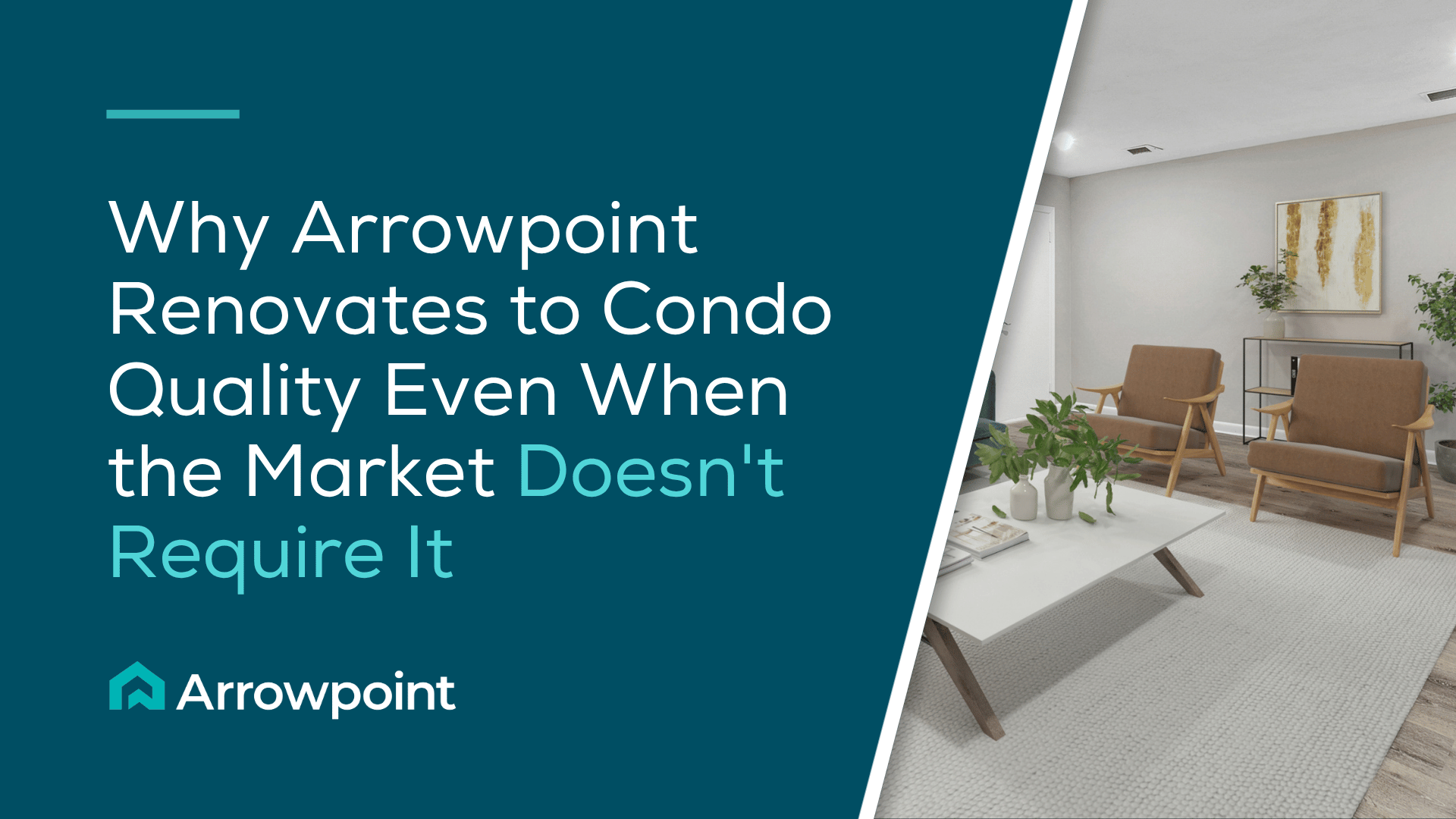
Arrowpoint probably overspends on renovation quality relative to what is strictly necessary to capture the rent premium. When they renovate a Class C unit, the finish level is high - quartz countertops, full cabinet replacements, new flooring, recessed lighting. Residents who have walked into units at comparable properties and seen a half-effort renovation notice the difference.
"We've had people just drive by that say, I can't believe that's the same property," Dave has said. "Just what we did on the outside, never mind the inside."
That reaction - someone who knows the building before and after, who sees the money that went into it - is marketing that cannot be bought. It builds the reputation of the property as a place worth living. It generates lease renewals. It creates referrals from existing tenants.
The philosophy traces back to something Dave read early in his career about making the best product on the market, even at a higher price point, because the quality becomes undeniable. Applied to workforce housing, that translates to: renovate to condo quality, let the tenant experience justify the rent, and trust that the asset will hold its value because the residents want to stay.
Frequently Asked Questions
What is the difference between Class B and Class C multifamily operations?
Class C multifamily - typically 1960s through 1980s vintage - requires more intensive management, more capital investment at acquisition, and a longer stabilization period before the asset performs at its potential. Renovation programs are heavier, tenant credit profiles may be more variable, and deferred maintenance from prior ownership is common. Class B assets, typically 1990s through 2000s vintage, are generally in better condition at acquisition. The lift is lighter, stabilization is faster, and the resident base tends to be more stable. Arrowpoint operates in both categories, applying the same management discipline to each while adjusting the business plan to match what the asset actually needs.
Why does Arrowpoint manage properties in-house rather than using a third-party manager?
Dave Lamattina built his property management operation before he ever raised outside capital. That sequence - operator first, syndicator second - is the foundation of the business. Keeping management in-house creates direct alignment between the sponsor and the property, and allows Arrowpoint to apply relationships it has built with local vendors and subcontractors over 20 years. The alternative - trusting a third-party firm with a portfolio of older workforce housing in a specific submarket - would mean outsourcing the most operationally intensive part of the business to someone who has not lived it.
How does Arrowpoint decide how much to spend on renovations?
The threshold is a 15-20% return on renovation dollars in year one. If the plan is to spend $15,000 per unit, the renovation needs to generate at least $200 per month in additional rent to clear the threshold. That number is set by comparing the renovated unit to comparable finished units already leasing in the same submarket. If the market cannot support the rent premium that would justify the renovation budget, the scope comes down. If the scope comes down below what it takes to compete in the market, Arrowpoint reexamines the acquisition price. The renovation return calculation is not aspirational. It is underwriting.
What does Arrowpoint's occupancy and collections track record look like?
The Merrimack Valley portfolio runs at approximately 98% occupancy. Collections across the portfolio are strong, though collections management has become more complex since the pandemic-era tenant assistance programs expanded. Massachusetts state assistance programs make funds available with minimal hardship requirements, which has produced more collection friction and more legal cases than Arrowpoint experienced before 2020. The occupancy number persists because demand in the Valley is structural - vacancy rates in core markets like Lawrence sit around 1.4%, and new supply at workforce rent levels cannot be built profitably at current construction costs - the gap at the heart of The $212,000 Problem.
How does Arrowpoint handle capital planning on older buildings?
Capital planning starts at underwriting. Arrowpoint sizes reserves based on a property-specific assessment of what the building will likely need - roofing, mechanicals, parking, exterior components - during the hold period, not a generic formula. On aging assets, that assessment is informed by two decades of operating buildings of similar vintage in the same climate. Certain items are non-negotiable replacements: heating and cooling failures, health code violations, fire and life safety systems. Other items are triaged based on condition and cash flow. The discipline is in knowing the difference, and in not having the PCR be the last word on what the building actually needs.
Next Steps for Investors
For investors evaluating Class B/C multifamily opportunities, Arrowpoint's investment approach is covered in detail in How to Invest in Real Estate Syndications. For a closer look at what hands-on operations looks like in practice, see the Worcester before-and-after case study, One Step Away From Condemned. To understand the collections and occupancy dynamics in the Merrimack Valley in more depth, see The State Cut a Check and Nobody Needed It.
Arrowpoint Properties accepts qualified investors on a deal-by-deal basis. Dave Lamattina gives out his cell phone. That is how he has run the business for 22 years.

David Lamattina
President & CEO
About Dave Lamattina
Dave Lamattina is the founder and CEO of Arrowpoint Properties, a vertically integrated multifamily owner-operator based in Lawrence, Massachusetts. He has been acquiring and operating multifamily assets in the Merrimack Valley for over 22 years, with 1,100+ units acquired and exited and a current portfolio of approximately 850 units valued at around $230 million. Arrowpoint has completed 26 syndications with an average net IRR of 32% and a 2.50x equity multiple.