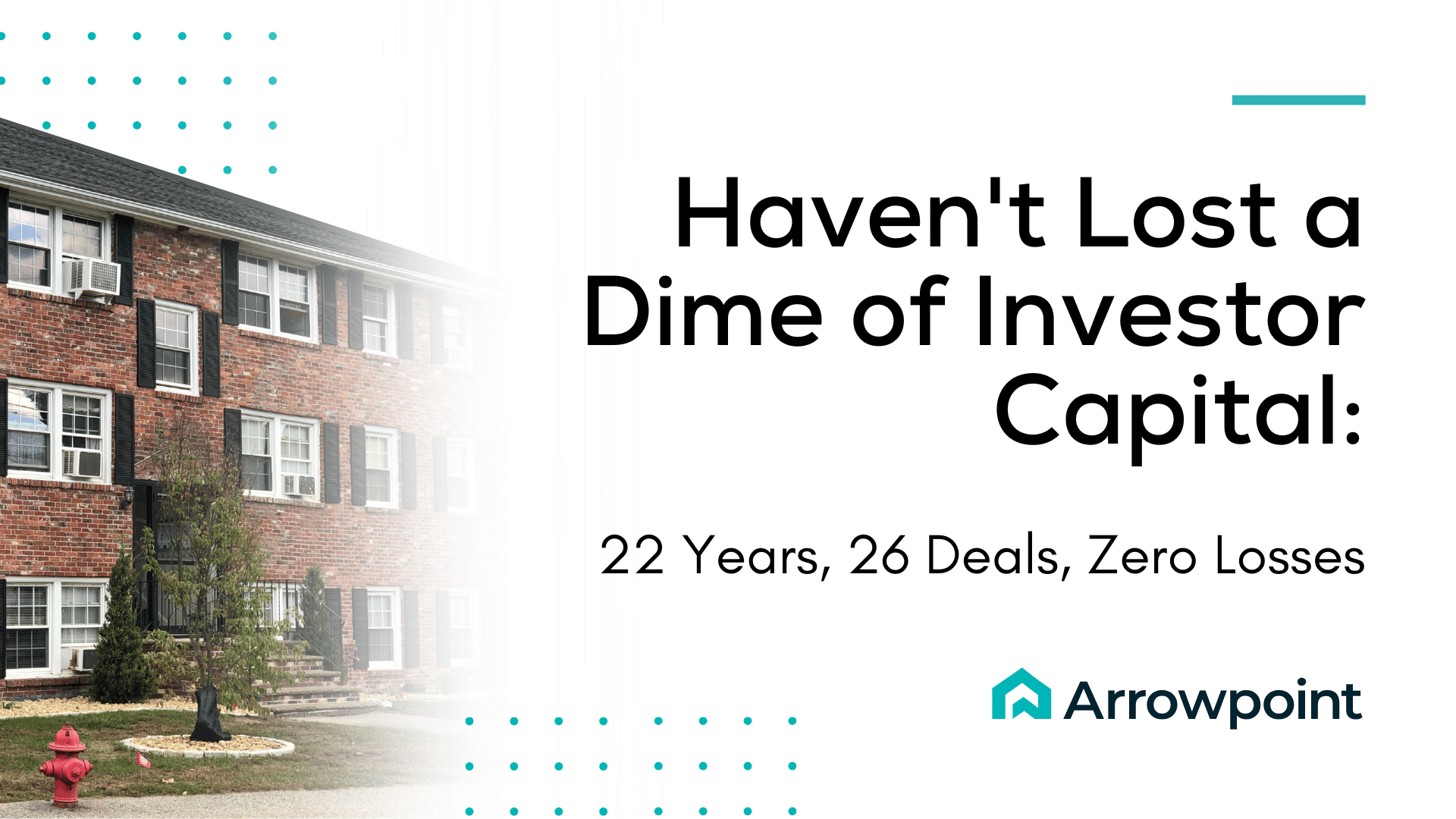
Arrowpoint Properties closes only two to three real estate syndication deals per year - deliberately. The Merrimack Valley workforce multifamily market produces limited deal flow by nature: long-term owners sell infrequently, and the assets that do trade often do not meet Arrowpoint's underwriting thresholds. But deal volume is also a choice. Arrowpoint does not do deals to generate acquisition fees. It does deals because the deals are right. That distinction is the most important thing an LP should understand before deciding which sponsor to back.
Key Takeaways
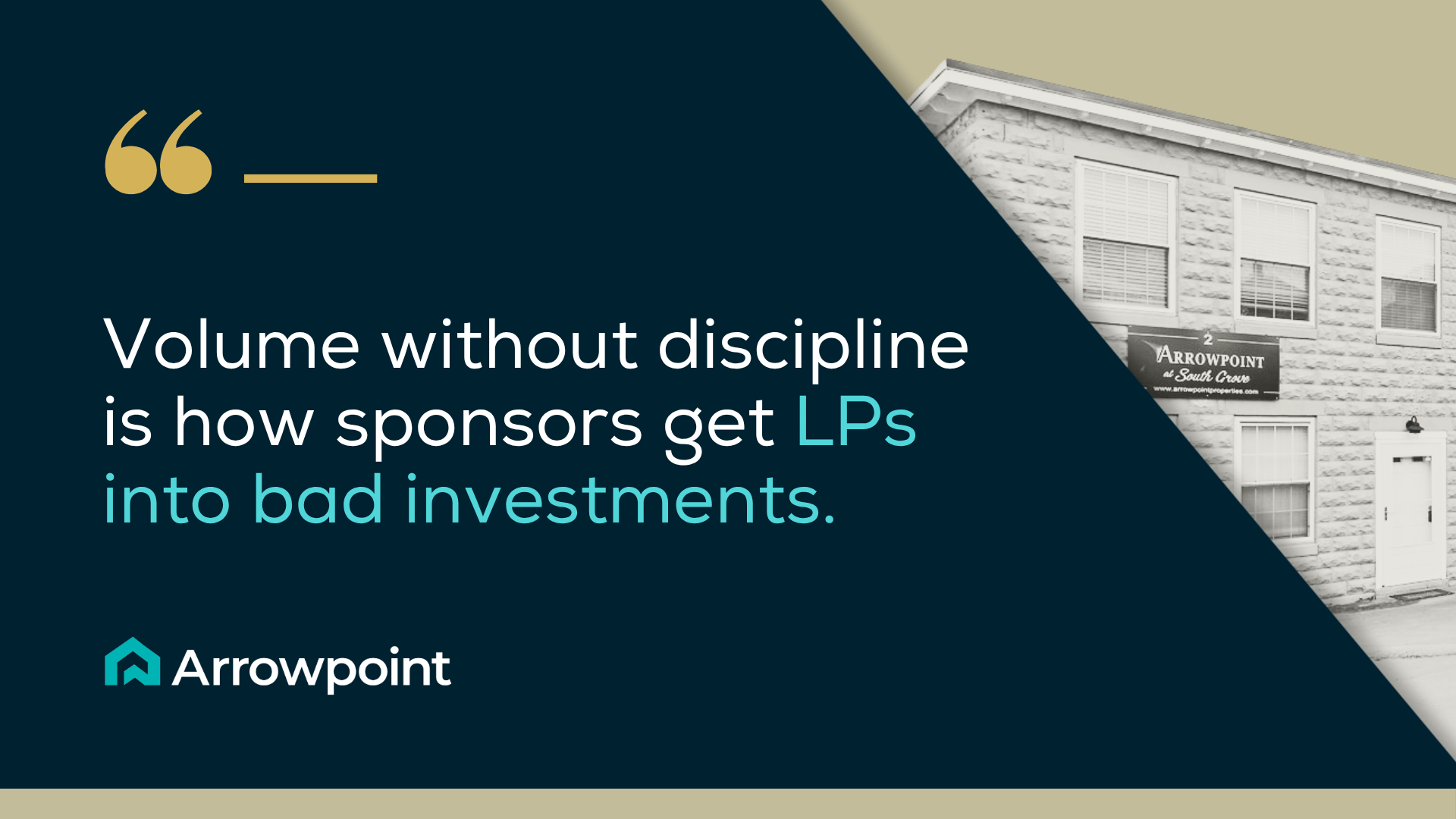
- A low deal count is not a capacity problem. Arrowpoint has the capital, the team, and the broker relationships to do more deals. It chooses not to, because volume without discipline is how sponsors get LPs into bad investments.
- The Merrimack Valley is a low-transaction market. Long-term family owners do not sell often. When they do, many assets are the wrong type or wrong price. The supply of viable deals is structurally limited - which is part of why Arrowpoint's 22 years of local knowledge matters.
- Fee-driven sponsors close more deals than their investors need. Acquisition fees, asset management fees, and promote structures all improve when deal count rises. A sponsor who co-invests in every deal has a different incentive structure than one who collects fees regardless of performance.
- Market concentration is the trade-off for deal frequency. Sponsors closing 15 deals a year are almost certainly spread across multiple markets. That breadth creates operational risk that concentrated operators do not carry.
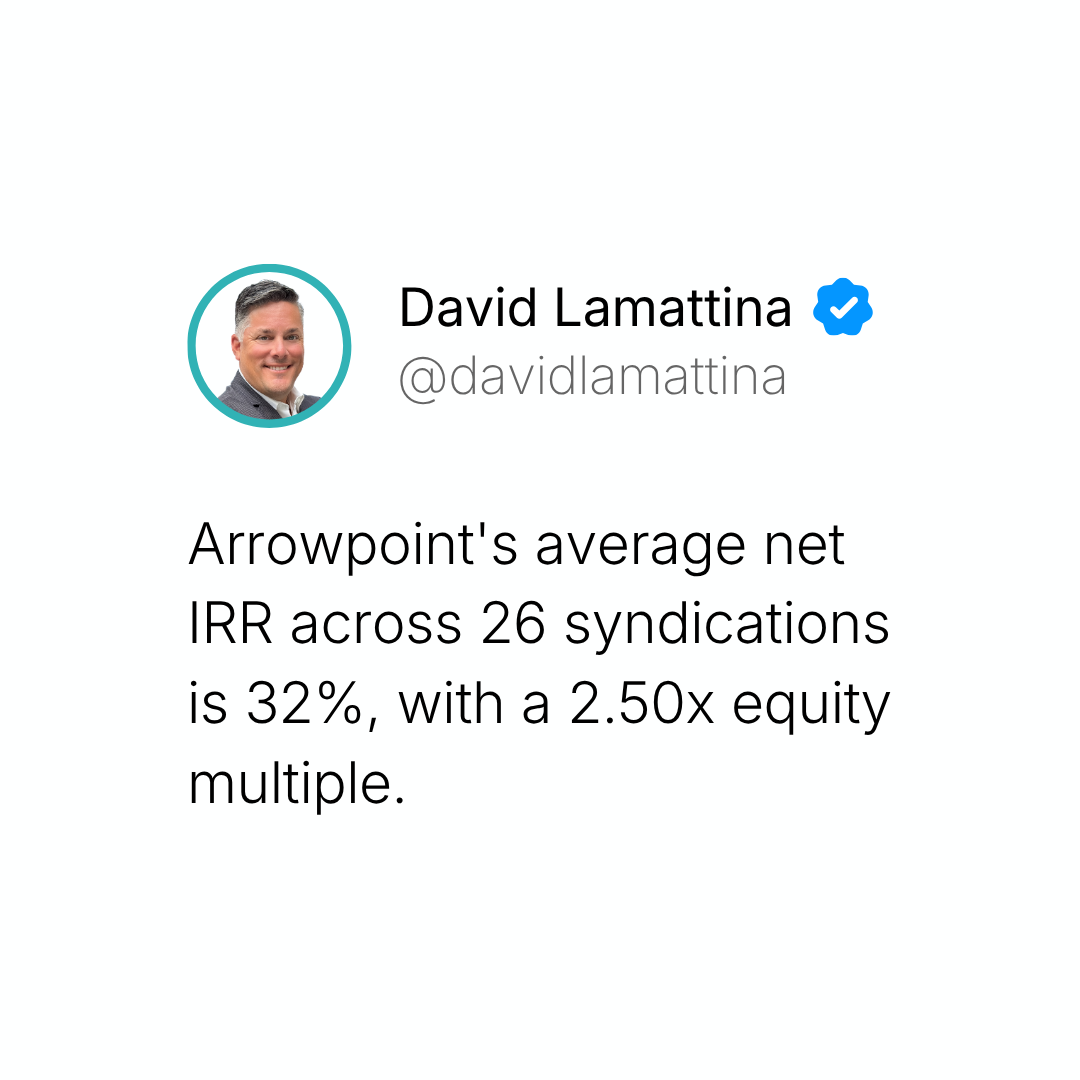
- Two to three good deals a year compounds faster than ten mediocre ones. Arrowpoint's average net IRR across 26 syndications is 32%, with a 2.50x equity multiple. That track record was built on selectivity, not volume.
- The right investor for Arrowpoint understands the model. LPs who need high deal frequency to feel their capital is working have a different risk appetite than Arrowpoint's investor base. Dave tells every new investor this on the first call.
The pattern described here - a concentrated operator in a single market, doing fewer deals with more discipline than the market average - is one of the most consistent predictors of long-term LP returns in private real estate. It is also one of the most underappreciated, because it looks unimpressive next to a sponsor who closes a deal every month - but it is exactly the pattern worth understanding when you learn how to invest in real estate syndications.
Subscribe to our educational newsletter and join the priority waitlist for our next offering
What Dave Says on the First Investor Call
When Dave Lamattina gets on a call with a new prospective investor, one of the first things he covers is deal frequency. He does not wait for the question. He volunteers it.
The explanation is straightforward: Arrowpoint does not do a lot of deals. On average, two or three a year. That is not going to change. The Merrimack Valley is not a high-transaction market - owners in the region tend to hold for a long time, and when they do sell, many of the assets are not the right profile for Arrowpoint. The ones that are right have to clear a specific underwriting threshold. The ones that do not clear it do not get done, regardless of how long it has been since the last closing.
This is the point where some prospective investors push back. They have seen other sponsors closing deals every other month. They wonder whether Arrowpoint is missing opportunities, or whether two deals a year means the business is not as active as it appears.
When an investor pushes back on deal frequency, Dave's response is simple: Arrowpoint is concentrated in one market, and that concentration is the point. Twenty-two years in the same geography means knowing what buildings are worth before walking in the door, knowing what renovations will cost before opening a spreadsheet, and knowing which brokers to call before a listing goes public. That depth of local knowledge is what Arrowpoint is selling - and it is only possible because the firm is not spread across a dozen markets chasing volume.
Why the Merrimack Valley Produces Limited Deal Flow
The Merrimack Valley - the roughly 36 towns and cities along the Massachusetts-New Hampshire border - is not a market that trades frequently. The workforce multifamily stock is largely held by long-term family owners who bought decades ago, collected cash flow, and have no particular motivation to sell. When a building does come to market, it is often because of an estate situation, a capital need, or a tax event. Those motivations produce irregular deal flow, not a steady pipeline.
Arrowpoint's first big deal, River's Edge in Haverhill, came off-market in 2016 through a broker relationship. The Elora deal that followed came the same way - a broker called before the listing went out because the relationship was strong enough that he wanted to give Arrowpoint a look first. Earlier in the firm's history, Dave was sending letters directly to owners. One of those owners was in Florida for the winter. They struck the deal over the phone. Dave had not even been inside the building yet.
That sourcing history - letters, broker relationships, off-market access built on two decades of being a serious, consistent buyer in one geography - is what produces Arrowpoint's deal flow. It is not a pipeline that can be scaled by hiring more acquisitions staff or expanding into new markets. It is a function of reputation and presence, built slowly and maintained carefully.
The practical implication is that Arrowpoint will not always have a deal open for investment. Sometimes a year passes with one closing. Sometimes two deals close in quick succession. The rhythm is determined by the market, not by a fundraising calendar.

The Fee Problem With High-Volume Sponsors
Most real estate syndication sponsors earn fees at multiple points in the deal lifecycle: an acquisition fee when a property is purchased, an asset management fee during the hold period, a construction management fee during renovations, and a promote on the back end when the asset is sold. Each of these fees scales with deal count. A sponsor who closes 15 deals a year earns 15 acquisition fees. One who closes three earns three.
This creates a structural incentive for volume. A sponsor can improve their firm's economics by closing more deals, even if the marginal deals are weaker than the core portfolio. The LP in deal number 14 may not be getting the same quality of attention - or the same quality of asset - as the LP in deal number four. But the fee structure does not distinguish between them.
Arrowpoint invests its own capital in every deal. Dave and his partners are LPs alongside outside investors in every syndication. That means the incentive structure points in one direction: do the deal only if the deal is worth doing. There is no fee-driven motivation to close a transaction that does not meet the return threshold. If the numbers do not work, the deal does not happen, regardless of when the last deal closed.
Dave's framing on first calls is that Arrowpoint is not doing deals for fees. If an investor wants a sponsor who generates a high volume of transactions, Arrowpoint is probably not the right fit. If they want a sponsor who is careful about what they close, who co-invests in every deal, and who has a 22-year track record built on selectivity rather than volume, then the deal frequency is a feature, not a concern.
What Market Concentration Actually Buys
Arrowpoint has been operating in the Merrimack Valley for more than two decades. That duration produces operational advantages that are difficult to replicate with capital alone.
Knowing what buildings are worth
Dave can look at an address in Lawrence or Methuen and have an immediate sense of what the asset should trade at, what the renovation program will cost, what the tenant profile looks like, and what the exit market is likely to support. That knowledge is not in a spreadsheet. It is accumulated through years of underwriting deals in the same geography, watching some close and others fall through, and running properties through multiple market cycles.
Knowing what things cost
Arrowpoint has contract pricing with Sherwin-Williams for paint and flooring and a commercial account with Lowe's that at one point made Arrowpoint the largest Lowe's customer in New Hampshire. It has go-to renovation contractors who have worked on dozens of Arrowpoint properties and know exactly what the firm expects. A sponsor entering a new market for the first time is paying retail on materials and getting estimates from contractors who do not know them. That cost differential flows directly into renovation returns.
Knowing the exit
The Merrimack Valley's investment characteristics - persistent rental demand, almost no new supply in the workforce housing segment, occupancy consistently near 98% in the core Arrowpoint markets - are not a surprise to Dave. He has been watching them play out for 22 years. When he underwrites an exit cap rate at a slight expansion to today's market, it is informed by watching how this specific market has priced assets through different conditions, not by importing assumptions from a national database.
The Investor Who Is Right for This Model
Arrowpoint's investor base is built on long-term relationships. Many LPs have been in deals for more than a decade. The repeat investor is the norm, not the exception. That is only possible if investors understand the model going in and have realistic expectations about what working with Arrowpoint looks like.
The right investor for Arrowpoint is not looking for quarterly deployment. They are looking for a sponsor who is careful with capital, who knows the market better than anyone else in it, who co-invests alongside them, and who has never lost an investor's principal across 26 deals and 22 years. They are comfortable holding for five years. They do not need to see a new deal every 90 days to feel that their allocation is being managed.
The wrong investor for Arrowpoint is one who treats deal frequency as a proxy for sponsor quality. In some businesses, volume signals strength. In real estate syndication, it can signal the opposite - a fee-generation model dressed up as an investment strategy.
Dave makes this distinction explicit on every first call as part of the initial qualification conversation. Investors who do not fit the model are better off knowing that before they wire any capital - a principle rooted in what Dave's father first taught him about investor relationships.
Two or Three Good Deals
Over 22 years, Arrowpoint has closed 26 syndications. That averages out to roughly 1.2 deals per year. The track record produced by that pace: 32% average net IRR, 2.50x equity multiple, no loss of investor capital.
That is the argument for selectivity, expressed in numbers rather than philosophy. A sponsor who closes 15 deals a year over the same period closes 330 transactions. They need to be right 330 times. Arrowpoint needs to be right 26 times and can afford to spend far more time and attention on each one.
The math is straightforward. The discipline required to actually live by it - to pass on a deal that almost works, to hold cash when the pipeline is thin, to tell a new investor that there may not be anything to invest in for the next six months - is harder than it sounds. It is also why the track record looks the way it does.
Frequently Asked Questions
Why does Arrowpoint only do two or three deals a year?
Two reasons. First, the Merrimack Valley workforce multifamily market does not trade frequently. Long-term family owners hold for decades, and the assets that do come to market often do not meet Arrowpoint's underwriting thresholds. Second, Arrowpoint does not close deals to generate fees. Every deal requires the same operational attention from the same team. Doing more deals would dilute that attention and increase the risk that a marginal asset gets through the filter. The volume limit is a deliberate choice, not a capacity constraint.
Should I be concerned that a sponsor only does a few deals a year?
The more useful question is why they are doing the number of deals they do. A sponsor closing two or three carefully selected deals in a market they know extremely well is a different risk profile from a sponsor closing 15 deals across multiple geographies to maximize fee income. Deal count is not a quality signal in either direction. What matters is whether the economics align the sponsor's interest with the LP's, whether the underwriting is conservative, and whether the track record holds up over multiple market cycles. Arrowpoint's 26-deal history across 22 years addresses all three.
What happens if there are no deals for an extended period?
Arrowpoint does not manufacture deals to fill a calendar. If the market is not producing assets that clear the firm's return thresholds, no deals get done. This has happened before - deal flow in the Merrimack Valley can be slow for extended stretches, particularly when sellers are holding out for prices the market is not supporting. In the current environment, Arrowpoint has been holding assets rather than selling into a thin buyer market, and has been patient on the acquisition side for the same reason. Capital preservation during slow periods is part of the discipline.
How does Arrowpoint source deals if it does not have a large acquisitions team?
Primarily through broker relationships built over 22 years of being a serious, consistent buyer in one geography. Brokers who know Arrowpoint call before listings go out because the firm has a reputation for performing - underwriting quickly, not re-trading, closing on time. Earlier in the firm's history, Dave sourced deals by sending letters directly to owners. The first Arrowpoint syndication in Lawrence in 2009 came from one of those letters. The owner was in Florida and they agreed on the deal over the phone.
Is Arrowpoint planning to do more deals per year as the portfolio grows?
The ambition is to do more deals in terms of unit count and deal size, not necessarily transaction frequency. Closing two or three deals that average 150-200 units each is different from closing two or three deals that average 30 units. Arrowpoint has been moving in that direction - the Elora acquisition, at over 100 units and $30 million, is an example of what the next stage of the portfolio looks like. The discipline around selectivity and market concentration does not change with deal size - it is the same discipline behind never losing a dime of investor capital.
Start Here If You're Evaluating Arrowpoint
If you are an accredited investor evaluating real estate syndication opportunities, the page on how to invest in real estate syndications with Arrowpoint covers the full picture - deal structure, return targets, hold periods, how distributions work, and what the LP experience looks like from first call to exit.
If you are specifically trying to understand Arrowpoint's track record and what 22 years without a capital loss actually means in practice, the article on Arrowpoint's capital preservation record across 26 syndications covers the methodology behind it.

David Lamattina
President & CEO
About Dave Lamattina
Dave Lamattina is the founder and CEO of Arrowpoint Properties, a vertically integrated multifamily owner-operator based in Lawrence, Massachusetts. He has been acquiring and operating multifamily assets in the Merrimack Valley for over 22 years, with 1,100+ units acquired and exited and a current portfolio of approximately 850 units valued at around $230 million. Arrowpoint has completed 26 syndications with an average net IRR of 32% and a 2.50x equity multiple.