After 22 years acquiring and managing workforce multifamily in the Merrimack Valley, Dave Lamattina is clear-eyed about the risks that come with this business. Aging buildings in a cost-inflation environment. The ongoing threat of rent control in Massachusetts, even after the most recent initiative was defeated in the courts. The Worcester properties, where a preferred equity structure has complicated the picture. These are real concerns, and investors deserve to hear them stated plainly. They are also the context for what lets Dave sleep: fixed-rate agency debt on every deal, underwriting that assumes conditions get worse rather than better, and a 22-year track record without a single dollar of investor capital lost.
Key Takeaways
- Aging buildings in a cost-inflation environment is the primary operational challenge. Insurance, labor, and materials have all moved significantly since the pandemic. On properties with tight cash flow, capital planning requires constant triage between what can wait and what cannot.
- Rent control remains a genuine risk even after the most recent initiative failed. The courts defeated the latest Massachusetts ballot initiative, but the political appetite for rent control has not gone away. Another attempt is a matter of when, not if.
- The Worcester preferred equity structure has underperformed projections. Dave has said so directly. The market softened, rates stayed high, and the pref group absorbs proceeds ahead of the LP group. It is the deal that tested the model the most.
- Fixed-rate agency debt is the structural answer to most of what could go wrong. Every Arrowpoint deal carries fixed-rate Fannie or Freddie financing at 70-75% LTV. No bridge loans. No rate caps. No refinancing risk during the hold period.
- The market fundamentals in the Merrimack Valley remain intact. Vacancy is tight, supply is not coming, and the tenant base provides demand stability that higher-end assets do not.
Property management is different every day. It can be stressful. The ongoing aging of some of the older buildings - especially as costs start to increase, labor, materials - there's only so much cash flow that can cover it. You have to decide what's a priority and what has to get done. - Dave Lamattina, Founder and CEO, Arrowpoint Properties
Subscribe to our educational newsletter and join the priority waitlist for our next offering
What Keeps Him Up: The Real List
Aging Buildings and Rising Costs
The core operational challenge for any workforce multifamily operator running older vintage stock is the same: buildings age, and the cost of maintaining them does not go down. Insurance has moved sharply since the pandemic. Labor costs are higher. Materials are higher. On a property that is cash-flowing comfortably, this is manageable. On a property where cash flow is tight and capital needs are accumulating, it requires constant decision-making about what gets addressed now and what waits.
There are no-choice items: a failed HVAC unit gets replaced because leaving a tenant without heat or cooling is not an option, and a Board of Health violation gets addressed regardless of timing. Other issues else gets triaged. The question is always where the money comes from and what the priority order is. On at least one property in the current portfolio, that conversation is active.
This is part of why Arrowpoint has shifted toward newer-vintage Class B alongside the older Class C stock. A 2009-build property does not carry the same capital demand as a 1970s garden-style building. The renovation lift is lighter, the systems are newer, and year-one cash flow is immediate rather than deferred through a rental program. The shift is a direct response to what the cost environment has done to older assets.
Rent Control
The most recent Massachusetts rent control ballot initiative was defeated in the courts. That outcome does not close the issue. The political constituency for rent control in Massachusetts is large and organized, and the conditions that produced the initiative - housing costs that have moved well beyond what working residents can absorb - have not changed. Another attempt will come. The form it takes and when it arrives are the only open questions.
For investors in Arrowpoint's Massachusetts portfolio, the practical concern is what a rent-capped environment would do to NOI and exit values. A policy that limits annual rent increases compresses the value-add thesis for older workforce housing and affects cap rate assumptions at exit, since buyers price regulatory risk into their offers. Dave does not treat this as a remote scenario. It is a risk he plans around.
The same dynamic that pressures existing owners creates opportunity for buyers with capital and staying power. If rent control suppresses valuations - and it will, in any market where it has been introduced - operators who can underwrite to a rent-controlled environment and hold through the uncertainty will be able to acquire at prices that would not exist otherwise. Dave has watched this market long enough to know that regulatory disruption tends to shake out the leveraged and the impatient. For a well-capitalized operator with fixed-rate debt and no pressure to sell, that is not only a risk to manage. It is a reason to stay.
The strategic response is already underway. Arrowpoint's most recent acquisitions have included assets in Southern New Hampshire, which has no state income tax, no rent control, and a supply-demand dynamic that mirrors the Merrimack Valley without the regulatory exposure. That pivot does not eliminate the Massachusetts portfolio risk - it is a hedge against the regulatory environment going forward, regardless of which specific initiative eventually succeeds. A full analysis of the rent control landscape and Arrowpoint's positioning is in Rent Control and the New England Investor.
The Worcester Properties
The three brick buildings in Worcester - acquired from long-term family ownership that had underinvested for years - required a full exterior rehabilitation after closing. New siding, new decks replaced with Juliet balconies, new parking lot, solar-powered hot water systems. Arrowpoint delivered on the physical renovation. The financial picture is more complicated.
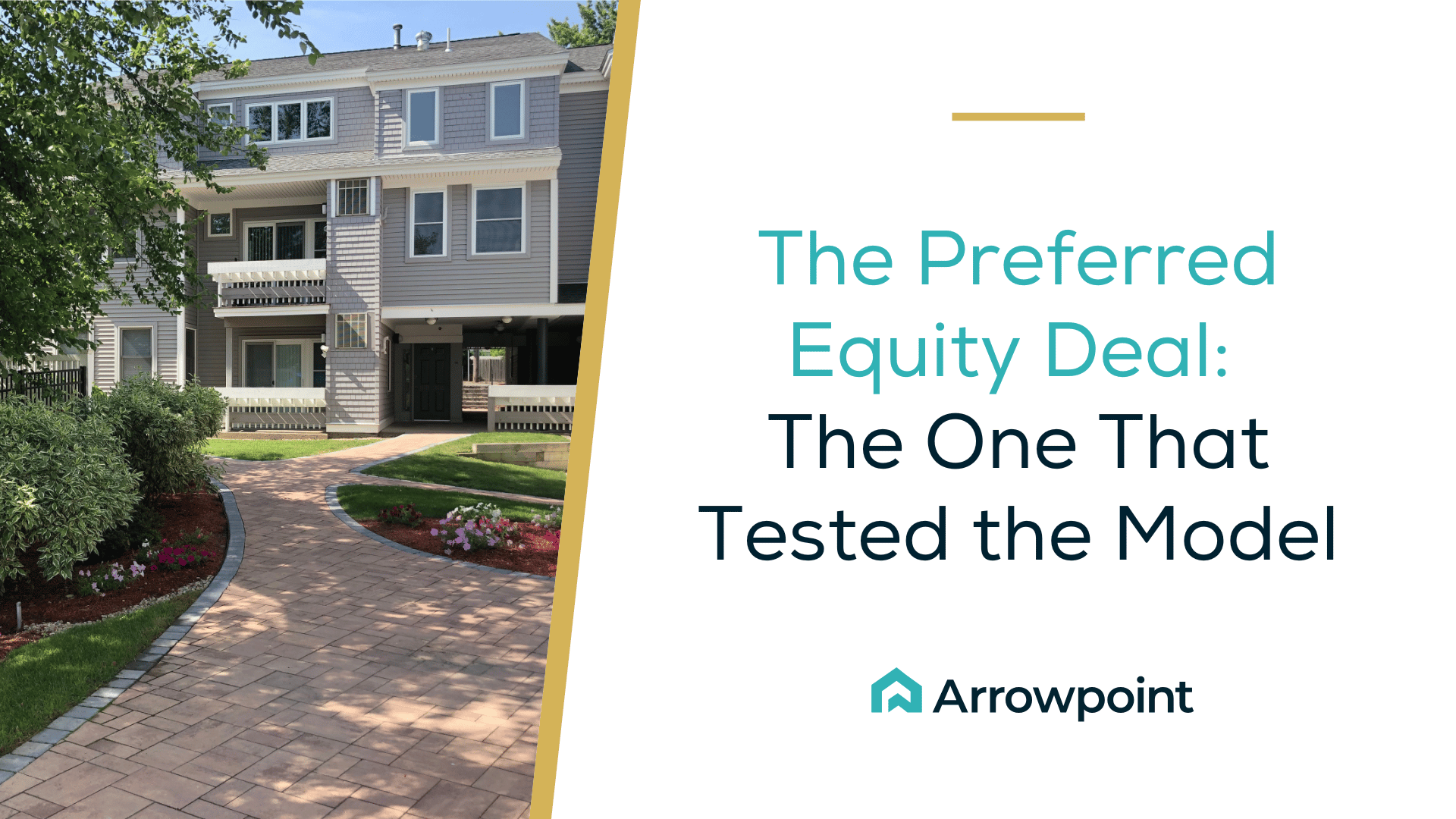
One of the Worcester deals carries a preferred equity structure that has not performed as projected. When the debt markets blew up in 2022 and the fund needed to close its first deal, a preferred equity group stepped up with capital that made the acquisition possible. In hindsight, Dave has said he wishes they had not taken it. The pref group sits ahead of the LP group in the waterfall, and with the market softening and rates staying elevated, the proceeds available to LPs have been compressed. The property has not failed - but it has not delivered what the original underwriting assumed.
It is the deal in the portfolio that has most tested the model, and investors deserve to know that.
What Lets Him Sleep
Fixed-Rate Debt on Every Deal
The single structural decision that eliminates the most risk in private real estate is also the simplest one: lock the rate at acquisition and do not touch it for at least five years. Arrowpoint carries fixed-rate Fannie Mae or Freddie Mac financing at 70-75% LTV on every deal. No bridge loans. No floating rate. No rate caps that expire and require refinancing at whatever the market is doing.
Dave watched what happened to sponsors who took short-term bridge debt into a rate spike environment. The math is unforgiving: a bridge loan that made sense at 3.5% becomes a capital call trigger at 7%. Arrowpoint has never issued a capital call, and the debt structure is a large part of why. When rates moved in 2022 and stayed elevated, Arrowpoint's deals kept performing because the financing cost was locked.
Conservative Underwriting That Assumes Things Get Harder
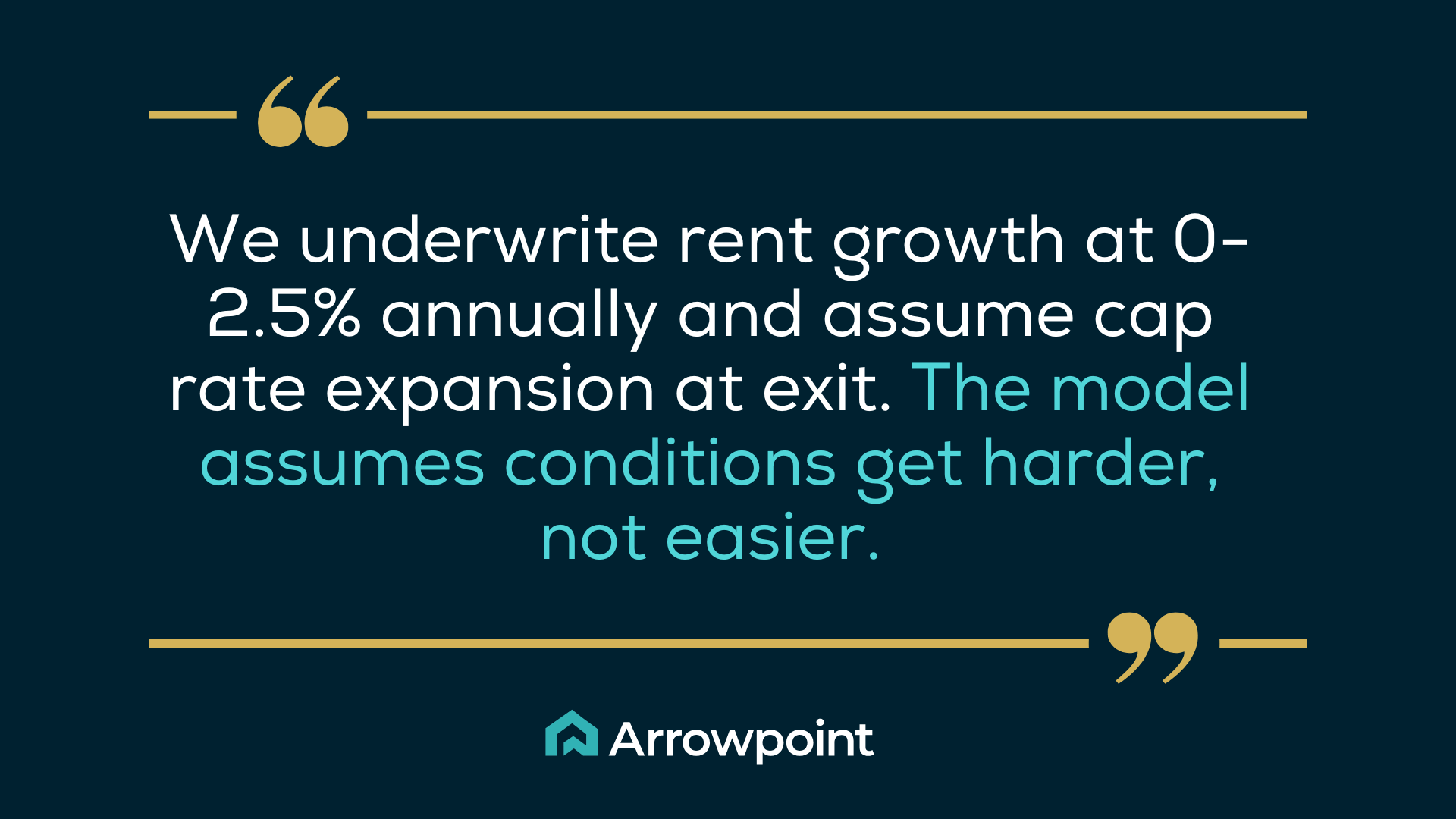
Arrowpoint currently underwrites rent growth at 0-2.5% annually - the low end of what most markets have historically produced. Exit cap rates are underwritten with expansion, not compression, built in. The model assumes conditions get somewhat worse rather than somewhat better.
This is a direct consequence of 22 years of watching what happens when underwriting assumptions are optimistic and the market does not cooperate. The deals that got sponsors into trouble in 2022-2023 were not deals with bad assets - they were deals with aggressive rent growth assumptions, floating rate debt, and exit cap rate projections that assumed continued compression. Arrowpoint's underwriting assumes the opposite, which is why the portfolio has held up through a period that broke a significant number of sponsors.
The Market Fundamentals Have Not Changed
Vacancy in Lawrence runs around 1.4%. The $212,000 gap between what it costs to build a new workforce unit and what workforce rents can support means new supply is not coming at this price point without subsidy. The tenant base - working-class residents employed locally, many of them long-term renters with no path to home ownership - is not going anywhere.
Dave acknowledges the market softened in 2024-2025. His read on the next few years is that the supply overhang clears, vacancy tightens again, and the fundamental demand story reasserts itself. That read is informed by 22 years of watching this market cycle, not by optimism. A full breakdown of the market thesis is in The Merrimack Valley Investment Thesis.
22 Years Without Losing Investor Capital
Across 26 syndications and every market cycle since 2009 - the financial crisis recovery, rising rate environments, post-pandemic cost inflation, a debt market dislocation in 2022 - Arrowpoint has not lost investor capital and has not issued a capital call. That record is the product of the debt structure, the underwriting discipline, and the operational depth that comes from 22 years in one market. It does not guarantee the next deal performs. It does indicate what the approach produces over time.
That is ultimately what lets Dave sleep: not that the risks are not real, but that the structure built around them has held through every version of adversity the market has produced so far. More on the approach that produced that record is in How We Underwrite Multifamily Deals.
Frequently Asked Questions
How does Arrowpoint manage capital needs on older buildings when cash flow is tight?
By triage. There are no-choice items - anything affecting habitability, health code compliance, or safety gets addressed regardless of timing. Everything else gets prioritized against available cash flow and reserves. Arrowpoint underwrites a capital reserve into every deal at acquisition specifically to handle unforeseen needs. On deals where capital demands are accumulating, the conversation between Dave and the property team is ongoing and active.
What is Arrowpoint's exposure to rent control risk in Massachusetts?
The most recent ballot initiative was defeated in the courts, but the political risk has not gone away. Massachusetts has a large and organized constituency for rent control, and the housing affordability pressures that drove the initiative remain. A future policy that caps annual rent increases would compress NOI on existing tenants, limit value-add upside on unrenovated units, and affect exit cap rate assumptions. Arrowpoint's response has been to begin building a position in Southern New Hampshire as a hedge - a market with no rent control and no state income tax. The Massachusetts portfolio remains subject to whatever regulatory environment eventually emerges.
Has Arrowpoint ever had a deal that underperformed projections?
Yes. The Worcester preferred equity deal has underperformed the original underwriting. The preferred equity group, which stepped in when the debt markets blew up in 2022 to make the acquisition possible, sits ahead of the LP group in the waterfall. With rates staying elevated and the market softening, the proceeds available to LPs have been compressed relative to projections. The property has not failed and the equity has not been lost, but the outcome has not matched what was originally underwritten.
Why has Arrowpoint never issued a capital call?
Primarily because of the debt structure. Fixed-rate agency financing at 70-75% LTV means there is no refinancing event during the hold period that could force a capital call to cover a rate reset or a maturing bridge loan. The underwriting also builds in conservative assumptions and capital reserves at acquisition, so unexpected costs can typically be absorbed without going back to investors.
Learn More
For more on how Arrowpoint structures debt and underwrites acquisitions to protect investor capital, see How We Underwrite Multifamily Deals and The 70-75% Rule. For context on the rent control landscape in Massachusetts, see Rent Control and the New England Investor.

David Lamattina
President & CEO
About Dave Lamattina
Dave Lamattina is the founder and CEO of Arrowpoint Properties, a vertically integrated multifamily owner-operator based in Lawrence, Massachusetts. He has been acquiring and operating multifamily assets in the Merrimack Valley for over 22 years, with 1,100+ units acquired and exited and a current portfolio of approximately 850 units valued at around $230 million. Arrowpoint has completed 26 syndications with an average net IRR of 32% and a 2.50x equity multiple.