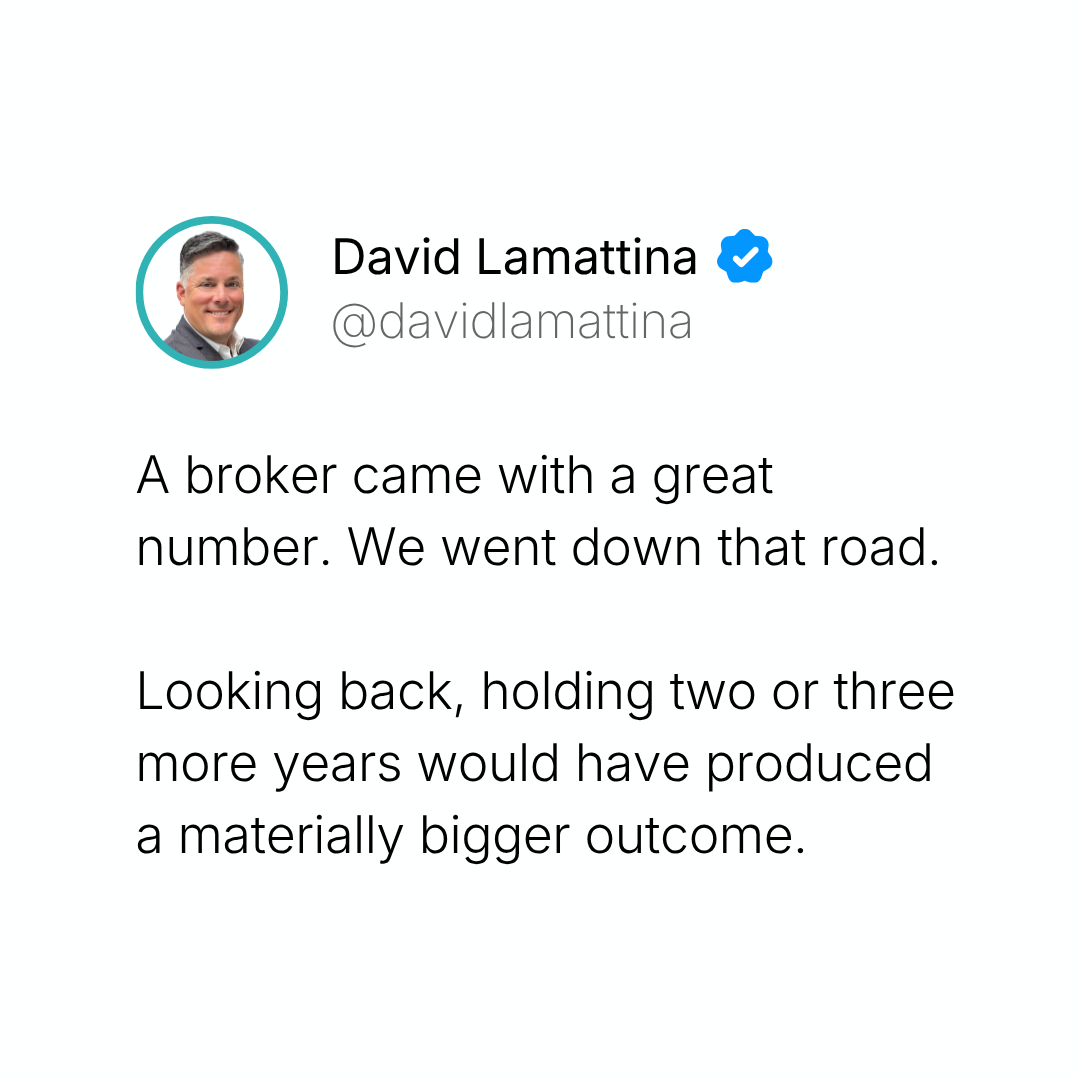
The most costly mistake in a multifamily hold is not a bad renovation or a problem tenant. It is selling before the business plan has finished working. Dave Lamattina sold a southern New Hampshire deal at year two on a five-year underwrite, returned low-to-mid 20s IRR to investors, and has thought about that decision ever since. A broker came with a number. They went down that road. Looking back, holding a few more years would have produced a materially bigger outcome. The deal was not a failure. It was a lesson about what patience actually costs when you do not have it.
Key Takeaways
- A decent IRR is not the same as the right exit. The southern New Hampshire deal returned low-to-mid 20s net IRR. That clears any reasonable threshold. The issue is not that it was a bad outcome - it is that a significantly better outcome was available and left on the table.
- Broker-driven exits are the most common source of premature sales. A broker approaches with an opinion of value, the number looks attractive, and the decision to sell gets made before the business plan has run its course. The broker has an incentive to transact. The operator's incentive is to maximize the hold.
- A five-year hold underwrite means the deal was sized to be held five years. Selling at year two means the renovation premium has not had time to compound into the exit value, the income stream has not seasoned, and the buyer is capturing the upside that should belong to the existing partnership.
- Fund structures create exit pressure that deal-by-deal structures do not. A closed-end fund has a timeline, and that timeline can push a sale into an unfavorable window. Deal-by-deal syndications preserve the flexibility to hold until conditions are right.
- Appleton Square is the counterexample. Offers came in at $40-42 million. Arrowpoint pulled it from the market. The number did not match the timing - not the other way around.
Dave Lamattina has completed 26 syndications across the Merrimack Valley and New England over 22 years. Exit timing is one of the most consequential decisions in any hold, and it is made under conditions of imperfect information. For the debt structure principles that preserve exit flexibility, see how to underwrite a multifamily deal.
Subscribe to our educational newsletter and join the priority waitlist for our next offering
The Deal
Around 2015, Arrowpoint acquired a roughly 50-unit complex in southern New Hampshire. It was a good deal at a good entry price. The plan was a five-year hold.
Two years in, a broker came with a number. Not an offer they could not refuse - just a number that looked reasonable enough to explore. They went down that road, reached a price, and sold.
The IRR came in somewhere in the low-to-mid 20s. That is a legitimate return. Investors were paid well. By most measures, the deal worked.
What Lamattina knows now is that holding another two or three years would have produced a materially bigger number. The market was moving. The property was performing. The business plan had more room to run. They were three years early.
Hindsight is easy. At the time, the number looked attractive but the lesson from that deal has informed every exit decision since: a decent offer at year two is not a reason to exit a deal that was underwritten for five.
How Premature Exits Happen
Most premature exits share the same origin: a broker calls with a number, and the number is attractive enough to start a conversation. From that point, the psychology shifts. The question stops being whether to sell and becomes whether the specific number is high enough.
That is the wrong question. The right question is whether the business plan has run its course. If the renovation program is not complete, if the rent roll has not seasoned, if the income the property is capable of generating has not yet materialized in the financials - then any offer, however attractive it looks in isolation, is pricing work that has not yet been done.
Buyers know this. An offer at year two on a value-add deal is priced to capture the remaining upside. The buyer is paying for a renovation program that is not finished and a rent roll that has not stabilized. The seller is accepting that pricing and handing the buyer the remaining value creation.
The alternative is to decline and let the business plan finish. That requires patience and the confidence that the plan is working. In the southern New Hampshire deal, the plan was working. The exit came before it finished.

The Fund Structure Problem
Closed-end fund structures add a layer of pressure that deal-by-deal syndications do not have. A fund operates on a timeline - capital is raised, deployed, and expected to be returned within a defined window. When that window approaches, the pressure to sell can outrun the optimal exit timing.
Arrowpoint launched its first commingled fund structure, Arrowpoint Multifamily Fund I, in early 2022. One of the things Lamattina likes least about the fund format is exactly this: the obligation to sell on a schedule, regardless of whether conditions favor it. If the market is soft when the fund timeline demands a sale, the operator is selling into weakness rather than strength. Deal-by-deal syndications preserve the flexibility to hold through a bad window and exit when the market cooperates.
If it were up to Lamattina, he says he would never sell anything. He would acquire, hold, and pass assets down. The reality of running third-party LP capital is that investors need to know their capital will come back on some reasonable timeline - not in 30 years. But the deal-by-deal structure, underwritten to a five-year hold, preserves maximum exit flexibility within that constraint. A five-year underwrite with fixed-rate debt means there is no forced decision before the business plan is done.
The Appleton Square Counterexample
Appleton Square in Methuen is what the alternative looks like.
Arrowpoint bought it in 2019 for under $30 million from the family that had developed it in 1988-89 - only the second owner in 30 years, which is unusual. They put close to 50 units through a full renovation: quartz countertops, blown-out kitchens, new cabinets, lighting, flooring. Added a dog park and a pavestone patio with built-in grills. It is the crown jewel of the Arrowpoint portfolio.
A broker brought an opinion of value. When the number came back, we were attracted to it. We launched the sale after the new year. Offers came in - significantly below where the broker had indicated. The rent control ballot initiative had become a hot-button issue, and buyers were pricing that risk into Massachusetts assets.
The preferred equity partner in that deal would have been paid – but LPs in the deal would have received far lower returns so we pulled it from the market and will revisit when conditions are right.
That decision - declining to sell at a number that does not reflect the value Arrowpoint created - is the lesson from the southern New Hampshire deal applied in real time. The exit is opportunistic, not obligatory. If the number is not there, the deal does not trade.

What Exit Timing Actually Costs
The cost of an early exit is not just the difference between the sale price and what the property might have eventually sold for. It is also the income stream that stops accruing to the LP from the moment of sale.
A property generating $300,000 in annual NOI, sold at year two instead of year five, costs the LP three years of distributions plus the additional value that three more years of income growth would have added to the exit price. At a 5.5% cap rate, every additional $25,000 in annual NOI adds roughly $450,000 in exit value. A renovation program that adds 20 more units to the premium rent tier during years three and four of a hold produces real additional exit value - value that belongs to the LP in a proper five-year hold and transfers to the buyer in a year-two exit.
The IRR math can still look good on an early exit because IRR is time-weighted. A 22% IRR over two years looks better in the model than an 18% IRR over five years, even though the dollar return to the LP is much larger in the second case. Equity multiple is the counterweight to that optical effect. A 2.5x multiple over five years returns more capital than a 1.4x over two years, regardless of what the annualized rate looks like.
Arrowpoint targets a minimum 2.0x equity multiple across deal types, with stronger deals targeting 2.5x. That target is part of why the full hold period matters: the multiple accumulates over time, and early exits truncate it.
How Arrowpoint Thinks About Exit Now
Every deal is underwritten to a five-year hold - not as a schedule but as a minimum. The deal is structured to be held for five years without requiring a sale. If a compelling offer arrives at year two or three, and the numbers justify a transaction including any yield maintenance cost, Arrowpoint will exit early. River's Edge was sold at year three with a yield maintenance penalty of almost $1.5 million and still returned 32% net IRR. In that case, it was the right call.
The difference between River's Edge and the southern New Hampshire deal is the margin. River's Edge attracted an offer strong enough to absorb a substantial prepayment penalty and still produce an exceptional return. The southern New Hampshire deal attracted a decent offer that produced a decent return and foreclosed a better one.
The test now is whether the offer price reflects the full value of the business plan, including the work not yet done. If it does, and the number is compelling enough, sell. If it does not - if the buyer is pricing in the remaining upside and the renovation program has room to run - hold. Let the plan finish.
Frequently Asked Questions
How does Arrowpoint decide when to accept an offer versus hold?
The starting point is whether the offer reflects the full value of the business plan. If significant renovation work is incomplete, or if the rent roll has not seasoned to reflect the upgrades already done, an offer at that moment is pricing in the remaining upside that should belong to the LP. The secondary question is whether the offer, including any yield maintenance cost, produces a return compelling enough to justify leaving the remaining hold period on the table. River's Edge cleared that test at year three. Not every early offer does.
Does a higher IRR on an early exit mean it was the right call?
Not necessarily. IRR is time-weighted, which means a strong two-year exit can show a higher annualized return than a stronger five-year hold. The equity multiple tells the fuller story: how many dollars did the LP get back for every dollar invested? A 2.5x multiple over five years produces more absolute capital than a 1.5x over two years, regardless of the IRR comparison. Arrowpoint tracks both, and the minimum equity multiple target of 2.0x is the guardrail against optimizing for the optics of a short-hold IRR at the expense of total investor return.
How does the fund structure affect exit decisions differently from deal-by-deal?
A closed-end fund operates on a defined timeline and creates pressure to sell within that window regardless of market conditions. If the fund timeline requires a sale in a soft market, the operator may be selling into weakness rather than strength. Deal-by-deal syndications, underwritten to a five-year hold with fixed-rate debt, preserve more flexibility: there is no fund-level deadline forcing a transaction, and the hold can extend if conditions warrant. Arrowpoint's preference is deal-by-deal for exactly this reason.
What is the role of yield maintenance in exit timing?
Fixed-rate agency debt carries yield maintenance provisions - prepayment penalties that compensate the lender for lost interest income if the loan is retired early. On a large deal with a long remaining term, that penalty can be substantial. At River's Edge, it came to almost $1.5 million. The yield maintenance cost is not a reason to hold past the right exit - it is a factor in the calculation of whether the offer price is strong enough to justify the early exit. If the net proceeds after yield maintenance still produce a compelling return, the deal trades. If not, hold.

David Lamattina
President & CEO
About Dave Lamattina
Dave Lamattina is the founder and CEO of Arrowpoint Properties, a vertically integrated multifamily owner-operator based in Lawrence, Massachusetts. He has been acquiring and operating multifamily assets in the Merrimack Valley for over 22 years, with 1,100+ units acquired and exited and a current portfolio of approximately 850 units valued at around $230 million. Arrowpoint has completed 26 syndications with an average net IRR of 32% and a 2.50x equity multiple.