When Arrowpoint Properties closed on three brick multifamily buildings in Worcester, Massachusetts, the properties had no functioning fire alarm systems, cantilevered exterior decks that posed an active liability risk, and a physical condition that the ownership team describes as one step away from condemned. Within four months of closing, every exterior element had been replaced or rebuilt - new siding, new parking lot, new Juliet balconies, solar-powered hot water, and a $250,000 sports amenity park built on a dirt pile the previous owners had left behind. The timeline was the direct result of having a one-stop exterior contractor on site every single day.
Key Takeaways
- The condition was severe. No working fire alarm systems. Cantilevered decks that represented an active liability risk. Long-term family ownership that had stopped investing in the property years earlier. This was not deferred maintenance at the margin.
- The exterior transformation was done in four months. Closing was August 1. All exterior work was complete by end of November. That pace required a single general contractor handling the full exterior scope, with a crew on site continuously.
- Cantilevered decks were ripped off and replaced with Juliet balconies. The original decks could not be repaired to an acceptable safety standard. Arrowpoint removed them entirely and installed Juliet-style balconies - a structural solution, not a cosmetic one.
- Solar-powered hot water with heat pumps replaced conventional systems. The capital investment addressed both the condition issue and reduced long-term operating costs.
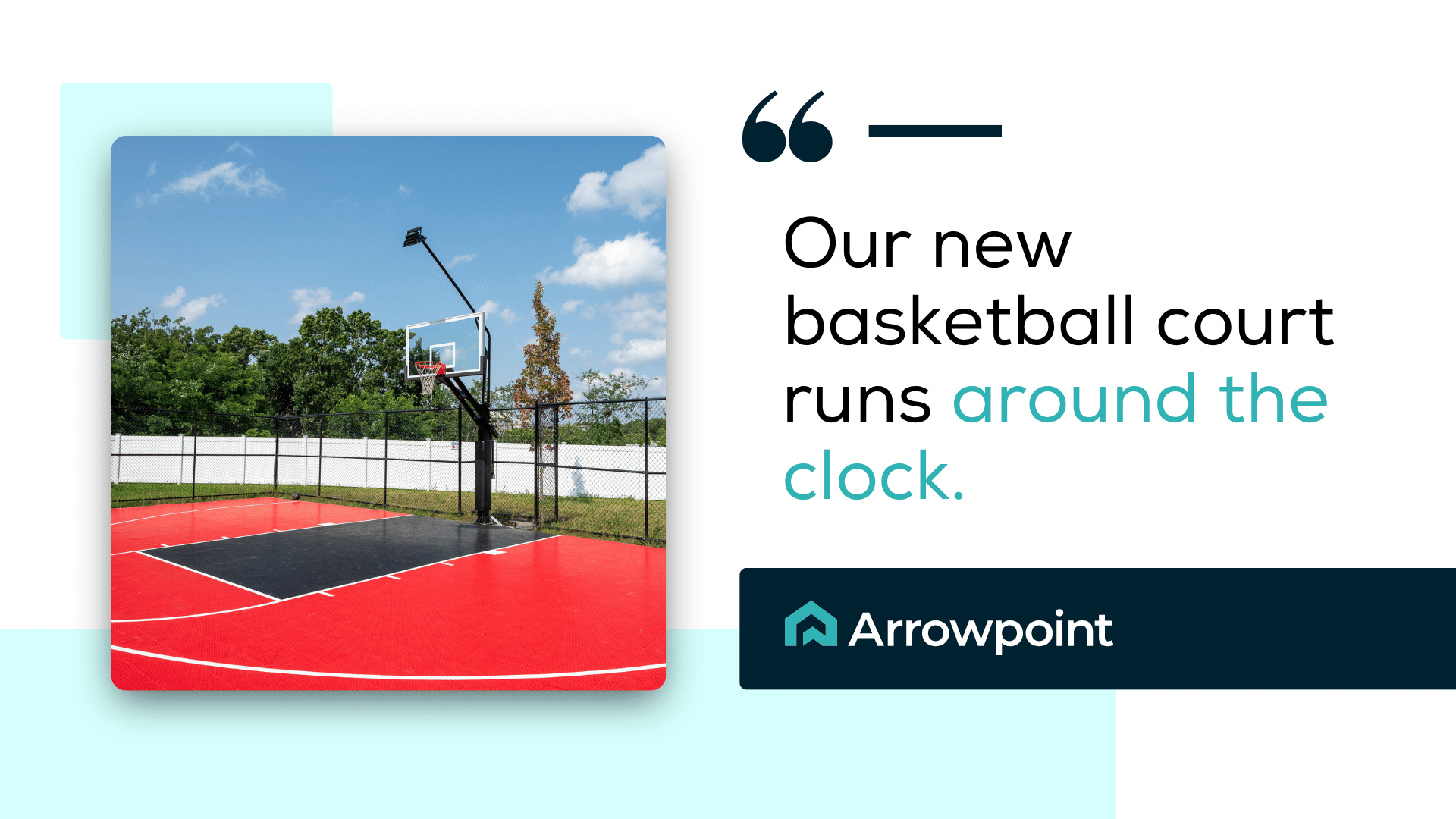
- The sports park turned a liability into an amenity. A large dirt pile behind the complex - left over from plans the prior owner never executed - became a pickleball court, a basketball court, paved walkways, built-in grills, post lighting, and landscaped fencing. Approximately $250,000 invested. The basketball court runs around the clock.
- Inside, the renovation standard held. Unit interiors were brought to the same condo-quality finish level Arrowpoint applies across its value-add portfolio: quartz countertops, new cabinets, full kitchen rebuilds, luxury vinyl plank flooring, recessed LED lighting.
Dave Lamattina has described the Worcester brick buildings as probably the worst condition property Arrowpoint has ever taken over. The exterior and interior transformation was completed while simultaneously managing the financing, leasing, and operational transition on a portfolio that was entirely new to Arrowpoint's management team.
Worcester represented Arrowpoint's first acquisition outside the Merrimack Valley core. The execution there was consistent with the standards applied to every property in the portfolio - the Class B/C operating discipline Arrowpoint runs firm-wide.
Subscribe to our educational newsletter and join the priority waitlist for our next offering

What Arrowpoint Actually Bought
The Worcester acquisition was three separate brick buildings, 1970s vintage, in a market that on paper looked compelling. Worcester is the second-largest city in New England. At the time Arrowpoint was evaluating the deal, apartment demand had ranked it among the top markets in the country. The research checked out.
What the research could not fully capture was the physical condition of buildings that had been held by a single family for decades and had not seen sustained capital investment in years. Fire alarm systems were non-functional. The cantilevered exterior decks - the kind of structural feature that looks innocuous until it fails - were compromised to the point where Arrowpoint's assessment was that they represented an active lawsuit waiting to happen.
Older family-owned buildings often present this profile. The family bought in 1975, managed the cash flow, let systems age, deferred replacement indefinitely. By the time the next buyer arrives, the building is structurally intact but operationally neglected. The gap between what the building could produce and what it was producing was not a function of market location. It was a function of ownership.
Arrowpoint closed on August 1.
The Exterior: Four Months, One Contractor, Every Day
The scope of exterior work on three brick buildings from the 1970s was significant: new siding across all three properties, a full parking lot replacement, removal of the cantilevered decks, installation of Juliet balconies in their place, and new solar-powered hot water systems with heat pump integration.
The decision on the decks was not close. Cantilevered structures of that age, in that condition, with no documentation of recent inspection or maintenance, are not candidates for repair. They were removed entirely. The Juliet balconies that replaced them accomplish the same functional purpose - residents still have access to exterior air from their unit - without the structural liability of a cantilevered platform.
The solar hot water conversion is worth noting because it sits at the intersection of capital replacement and long-term economics. When a water heating system needs replacement anyway, the incremental cost of converting to solar with heat pump backup is a capital decision that reduces ongoing utility expense. The system was installed because the existing system needed to go and the better replacement happened to be more efficient.
Everything was done by November 30. That is four months of exterior work across three buildings, completed through fall in Massachusetts. The mechanism was straightforward: one contractor, responsible for the full exterior scope, with a crew present on site every day. There were no handoffs between subs, no coordination gaps, no periods when work was paused waiting for the next trade to mobilize. The contractor owned the timeline end to end.
People who drove past these buildings before and after the work was done and did not know what to make of what they were looking at. The transformation was visible from the street.
The Dirt Pile Behind the Building
Behind one of the Worcester buildings, the previous owner had left a large graded dirt area where they had planned to develop additional units. The plans were never executed. What remained was an oversized patch of unpaved ground that contributed nothing to the property and communicated, to anyone who saw it, that the previous ownership had given up.
Arrowpoint leveled it and built a sports amenity park with a pickleball court and a full basketball court. A paved walkway connecting the two, lined with post lighting, leading out to a pair of rounded patio areas with built-in grills and seating. The whole perimeter was fenced and landscaped for privacy.
The total cost was approximately $250,000.
The pickleball court gets occasional use. The basketball court runs around the clock. That outcome was not predictable in advance - the pickleball installation made sense given the amenity trend at the time of construction. What was predictable was that investing $250,000 in a useless dirt pile and converting it into an amenity space would change what residents experienced every day and what prospective tenants saw when they toured.
Amenity investment is not about the amenity. It is about signaling - to current residents that ownership is spending money on their living environment, and to prospective residents that this is a place someone cares about. Both signals reduce turnover. Reduced turnover reduces the vacancy-driven maintenance expense that erodes cash flow on older buildings faster than almost any other factor.
Inside the Units
The exterior work ran concurrently with the interior renovation program. Vacant units were turned first - that is always the sequence on Arrowpoint acquisitions. Day one after closing, any unit sitting empty goes into renovation.
The interior standard on the Worcester buildings matched what Arrowpoint applies across its Class C portfolio. Quartz countertops. Full cabinet replacements. Kitchen layouts opened where the floorplan allowed. Luxury vinyl plank flooring throughout. Recessed LED lighting. Appliance upgrades. The same finish level that produced the before-and-after reaction on the exterior - people driving past who could not believe it was the same property - was applied inside every renovated unit.
That consistency is the point. A building that looks transformed from the street but delivers a dated interior on move-in day loses half the argument. The renovation standard holds from the parking lot to the kitchen counter.
What the Worcester Deal Teaches About Hands-On Operations
The Worcester acquisition was Arrowpoint's first outside the Merrimack Valley core, and it has not been without complexity. The capital structure on the first Worcester deal - which included a preferred equity component - has produced returns below projections, primarily because the preferred equity draws create a drag that standard LP equity does not. The property itself cash flows. The structure is the issue, and it is one Arrowpoint does not intend to repeat.
What the physical turnaround demonstrated, separately from the capital structure, is what the phrase hands-on operator actually means in practice. Four months, exterior complete. Fire alarms functioning. Decks replaced. Solar installed. Dirt pile gone. Units renovated to a standard the prior owner had never attempted.
That kind of execution does not come from a third-party management firm receiving a work order and scheduling a site visit. It comes from an ownership team that was on site, managing the contractor relationship directly, making decisions in real time, and operating with the expectation that the work would be done before winter.
For more on Arrowpoint's approach to capital planning and what inspections miss, see What Inspections Don't Find. For the broader operations framework this deal fits within, see Class B/C Multifamily Operations.
Frequently Asked Questions
How did Arrowpoint handle the fire alarm systems that weren't functioning?
Life safety systems are non-negotiable capital items. When Arrowpoint took ownership of the Worcester buildings and confirmed that the fire alarm systems were not operational, the remediation went to the top of the priority list. There is no version of the business plan where tenants occupy buildings without functioning fire alarms. That work was addressed immediately after closing, ahead of any cosmetic or value-add renovation scope.
Why replace the cantilevered decks entirely rather than repair them?
Cantilevered decks of that vintage and in that condition do not have a reliable repair path. The structural risk of a compromised cantilever is not marginal - a failure event creates liability and asset-level exposure that makes the cost of full replacement look trivial by comparison. Arrowpoint removed the decks and installed Juliet balconies, which provide residents with exterior access while eliminating the structural liability entirely. This was a risk management decision before it was a renovation decision.
What drove the decision to build a sports amenity park rather than additional parking or other improvements?
The dirt area behind the building had been designated for additional units that the prior owner never built. Converting it back to parking would have consumed the $250,000 budget without generating any meaningful amenity value. The sports park - courts, patios, lighting, landscaping - created a resident-facing amenity that differentiated the property from comparable buildings in the area. The basketball court in particular has been consistently used since installation. Amenities that get used justify the capital by producing the tenant satisfaction and retention that reduces vacancy costs over time.
Does Arrowpoint plan to acquire more Worcester properties?
Worcester represented Arrowpoint's first acquisition outside the Merrimack Valley core. The market fundamentals that drove the original decision - population growth, strong apartment demand, a supply-constrained environment - remain relevant. The capital structure lesson from the first Worcester deal (no preferred equity) is applied going forward. Whether additional Worcester acquisitions happen depends on deal quality and pricing, but the market is not off the table - it fits the same Merrimack Valley investment thesis.
Arrowpoint Properties acquires value-add multifamily throughout the Merrimack Valley and select adjacent markets. For an overview of the investment thesis and how Arrowpoint underwrites deals, see the Merrimack Valley Investment Thesis. For information on investing alongside Arrowpoint, see How to Invest in Real Estate Syndications.

David Lamattina
President & CEO
About Dave Lamattina
Dave Lamattina is the founder and CEO of Arrowpoint Properties, a vertically integrated multifamily owner-operator based in Lawrence, Massachusetts. He has been acquiring and operating multifamily assets in the Merrimack Valley for over 22 years, with 1,100+ units acquired and exited and a current portfolio of approximately 850 units valued at around $230 million. Arrowpoint has completed 26 syndications with an average net IRR of 32% and a 2.50x equity multiple.