In 2022 and 2023, as interest rates rose and deal flow dried up across the country, a particular type of multifamily operator became visible in the wreckage - the ones who had expanded aggressively into markets they didn't know, using debt structures they couldn't sustain, managing assets they couldn't see from their office window. I watched it happen from 290 Merrimack Street in Lawrence, Massachusetts, where I have sat for most of my professional life.
I didn't buy in Phoenix. I didn't buy in Atlanta. I bought close to where I grew up, in buildings I can drive to the same day without planning around it, and I have never seriously considered doing anything else.
Key Takeaways
- Geographic focus is an operational advantage, not a limitation - 22 years in one market produces a depth of knowledge no out-of-market buyer can replicate at any price: pricing intuition, submarket awareness, broker relationships, contractor networks.
- The proximity principle is not a mileage rule - it is a knowledge rule - every asset in the portfolio is close enough to drive to the same day without planning around it. What matters is whether I know the market the way I know my own neighborhood.
- Operators who stayed in their lane came through the 2022-23 cycle intact - the ones who expanded into unfamiliar markets with floating-rate bridge debt are still working through the consequences.
- Our 85 Unit Bedford acquisition is not a departure from the principle - it is the principle applied to a new set of circumstances. I drove there in under 45-minutes before making an offer. The market dynamics are an extension of the same thesis I have applied in the Valley for 22 years.
- Concentration in one market - managed by someone who has been there for 22 years, is not the same risk as concentration managed by someone who arrived three years ago - our track record is the proof.
- LPs who want geographic diversification can build it across their own portfolio - what is harder to find is an operator with 22 years of continuous operation in a single geography, 26 syndications, and a track record of exits to show for it.
The Decision That Was Never Really a Decision
Dick Goldberg - the man who would become my mentor and whose son Jay is now my partner - invited me up to his office on a Friday in February of 2002 or 2003. I was 22, recently out of Fairfield University, still figuring out what I wanted to do with my life. I woke up that morning to a snowstorm and thought about canceling. I didn't. I got in my two-wheel drive sedan and drove up anyway.
Dick couldn't believe I showed up. He still tells that story.
He put me in his pickup truck and drove me around the North Shore for the rest of the morning, pointing out properties his family had owned since 1972 - that one since 75, that one since 83. A generational real estate family on the North Shore of Massachusetts, deeply rooted in one geography, deeply knowledgeable about every building and every street. I sat in the passenger seat and got an education that no classroom could have provided.
That is the tradition I stepped into when I bought my first four-family in Lawrence in 2004. I borrowed some money from my father, had no idea what I was doing, and started learning by doing it - changing toilets, painting units, figuring out tenant screening on the fly. It was not glamorous. It was the right start.
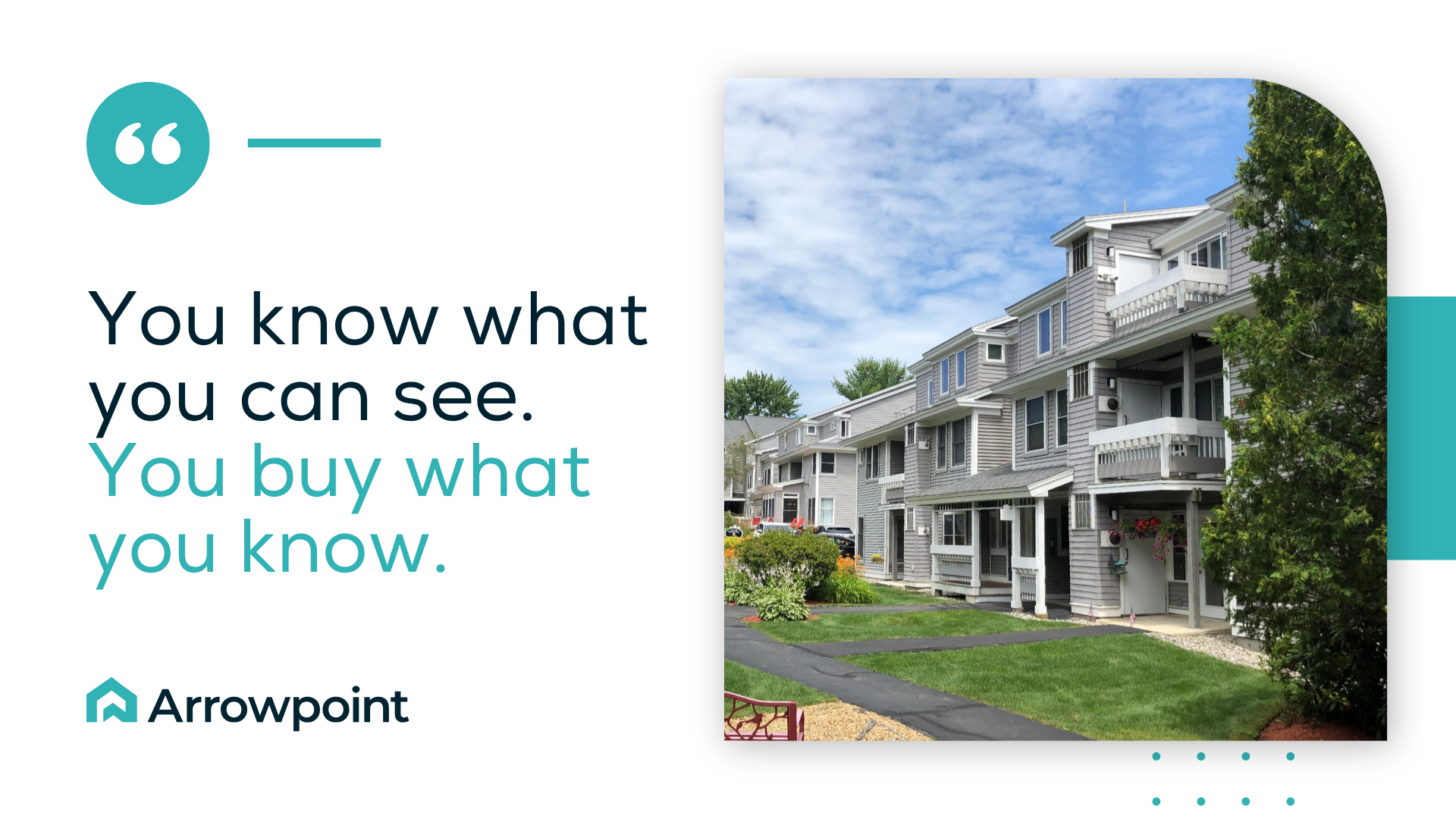
The geographic constraint was never a strategic choice in any formal sense. It was the natural expression of how I learned this business. You buy what you know. You know what you can see.
Subscribe to our educational newsletter and join the priority waitlist for our next offering
What Proximity Actually Buys You
Hands-on means something specific to me. It does not mean I am out swinging a hammer - we have contractors and a maintenance team for that. It means that when something comes up at a property, I can get there the same day and put my own eyes on it. I am not relying on a chain of information passed through a regional manager in another time zone. I am not getting on a plane to look at a maintenance issue in Texas.
That proximity compounds into competitive advantage over time in three ways.
Market knowledge. I have watched rents, vacancy, tenant profiles, and neighborhood dynamics in the same submarkets for two decades. I know what a building in Lawrence should cost before the broker sends the offering memorandum. I know which streets have turned and which haven't, which towns have improved their school systems and which haven't, which landlords maintain their properties and which let them deteriorate. None of that knowledge is available to an out-of-market buyer (in any market) at any price. You have to earn it by showing up, year after year, in the same place.
Speed of response. Appleton Square in Methuen - what I call the crown jewel of our portfolio, 140 units, a 1988 build we bought from the original development family - is down the road from our office in Lawrence. We bought it for just under $30 million. At one point we had offers between $40 and $42 million and pulled it off the market because I didn't want to sell it. The ability to make that decision confidently comes from knowing the asset intimately. I have been in that building more times than I can count. I know every deferred maintenance item, every unit, every renovation we have done. You cannot manage a decision like that from a distance.
Relationship continuity. The contractors who give us volume pricing have been working with us for years. The Sherwin-Williams account, the commercial Lowe's relationship, the exterior contractor who handles roofs, windows, siding, and decks as a one-stop shop - these are not relationships you inherit when you buy a building. They are built transaction by transaction, over years, in one place. A new entrant to this market is paying retail. We are not.
What Happens to Operators Who Don't Stay in Their Lane
During the COVID era, a wave of new sponsors entered multifamily - some of them buying dozens of assets across multiple states simultaneously, using short-term floating-rate bridge debt, managing through layers of third-party property management, and presenting to LPs as if geographic diversity were the same thing as risk management.
Dick Goldberg taught me something early on that I have never forgotten. He said: you have to have staying power. You have to be able to outlast downturns. The groups that survive every cycle are the ones that bought conservatively, used sensible debt, knew their markets, and didn't confuse expansion with sophistication.
The 2022-23 rate cycle was a test of that principle. Like us, the operators still standing - the ones who did not have a capital call, who did not face distressed debt situations, who did not have to sell assets at a loss - are almost exclusively the ones who had been in their markets for a long time, had used fixed-rate non-recourse debt with five-to-seven year terms, and had not overextended into geographies they couldn't manage. I was watching from the same office I have always been in. The same streets. The same market I have known since 2004.
We have completed 26 syndications across the Merrimack Valley and greater Worcester without a capital call. That is the product of knowing one market deeply enough to buy conservatively in it, and having the operational infrastructure close enough to run the assets properly when things get complicated.
The New Hampshire Question
The Bedford, New Hampshire, acquisition in February 2026 looks, on the surface, like geographic expansion. Eighty-five units at $24.05 million - Northmarq described it as a record-breaking per-unit price for sub-200-unit multifamily transactions in Southern New Hampshire. Some people have asked me whether it represents a departure from the philosophy that has defined everything else we have done.
It does not. I drove to Bedford before making an offer. Close enough to get there when I need to be there, close enough that I know the market and have relationships on the ground. The deal dynamics are an extension of the same thesis I have applied in the Merrimack Valley for 22 years - supply-constrained workforce and middle-market housing, durable demand, an operator with local knowledge in a market where institutional capital is just beginning to arrive.
What is different about Bedford is the regulatory environment. New Hampshire has no state income tax, no sales tax, and no rent control at any level. The Massachusetts rent control ballot initiative - which would cap annual rent increases at the lower of CPI or 5% and has 62.6% voter support in current polling - is a real risk to value-add return profiles on Massachusetts assets. Our Massachusetts value-add programs are substantially complete. We are not adding Massachusetts exposure at current cap rates when we can acquire in Bedford with none of that regulatory overhang.
The principle has not changed. Apply deep local knowledge in supply-constrained markets, buy conservatively, use fixed-rate debt, operate well. Bedford is one commute north of where I have always worked. It fits.
What This Means for an Investor
The investor implication of geographic concentration is usually framed as a risk - single-market exposure, regulatory concentration, no diversification. I hear that argument. It deserves a direct response.
Concentration in one market, managed by an operator who has been there for 22 years, is not the same risk as concentration managed by someone who arrived three years ago. The depth of knowledge, the relationship network, the operational infrastructure, and the track record of 26 deals without a capital call are the products of staying put. They cannot be manufactured by a decision to focus. They have to be accumulated over time, through cycles, in one place.
LPs who want geographic diversification can build it across their own portfolio - allocating to a Texas operator, a Southeast operator, and a New England operator, each of whom knows their geography deeply. What they cannot build by assembling a collection of sponsors is what a single operator who has been in one market for two decades actually knows. That knowledge is not transferable and not replicable. It is the product of 22 years of blizzards and pickup trucks and buildings that don't look anything like what they used to.
Frequently Asked Questions
Why not expand into other markets if the Merrimack Valley thesis is so strong?
Because I don't know other markets the way I know this one. I have looked at deals in Rhode Island occasionally - never bought one. I have no interest in Connecticut. Maine doesn't produce enough deal flow. Vermont is a non-starter. I know what a building in Lawrence should cost. I know when a seller is realistic and when they are testing the water. I know the brokers who control deal flow in Essex County. None of that transfers. The edge I have here disappears the moment I buy somewhere I don't have 22 years of context.
How does the Worcester portfolio fit the proximity philosophy?
Worcester sits slightly outside our core Merrimack Valley geography, and we went in with our eyes open about that. Three assets, approximately 270 units, in a market with strong fundamentals - Massachusetts's second-largest city, anchored by healthcare and higher education, with Class B/C vacancy that runs well below the Class A segment where new supply has been delivering. The deals made sense on their own terms and they have performed. What Worcester taught us is that the proximity principle is about more than drive time - it is about the depth of market knowledge that only comes from years of operating in one place. We know the Merrimack Valley at that level. Worcester we know well enough. Whether we add to that portfolio or eventually rotate capital back toward our core markets will depend on what the right opportunities look like when they come.
What does 'staying power' actually mean in practice?
Dick Goldberg used the phrase often. In practice it means: conservative LTV - we target 70-75%, non-recourse, fixed-rate debt with five-to-seven year terms. No floating-rate bridge debt. No business plans that require everything to go right simultaneously. Underwriting that assumes costs will go up and rent growth will be slower than the optimistic case. The operators who had staying power in 2022-23 were the ones who had built buffers into every decision when times were good. That discipline looks inefficient in an up-market and essential in a down one.
How do you think about the New Hampshire expansion going forward?
Bedford is the beginning of what I expect to be a deliberate reorientation toward southern New Hampshire, driven primarily by regulatory risk in Massachusetts and the favorable operating environment across the border. We know the market, we have the relationships, and the fundamentals - supply constraints, strong tenant base, no rent control - are the same thesis applied to a different geography. The knowledge rule still applies. I am not buying somewhere I don't know.
The market fundamentals that made staying in one place pay off for 22 years are laid out in The $212,000 Problem and Renters for Life, and the debt discipline that mirrors this geographic discipline is the subject of Staying Power.

David Lamattina
President & CEO
About Dave Lamattina
Dave Lamattina is the founder and CEO of Arrowpoint Properties, a vertically integrated multifamily owner-operator based in Lawrence, Massachusetts. He has been acquiring and operating multifamily assets in the Merrimack Valley for over 22 years, with 1,100+ units acquired and exited and a current portfolio of approximately 850 units valued at around $230 million. Arrowpoint has completed 26 syndications with an average net IRR of 32% and a 2.50x equity multiple.